Convert millilitres to US cups
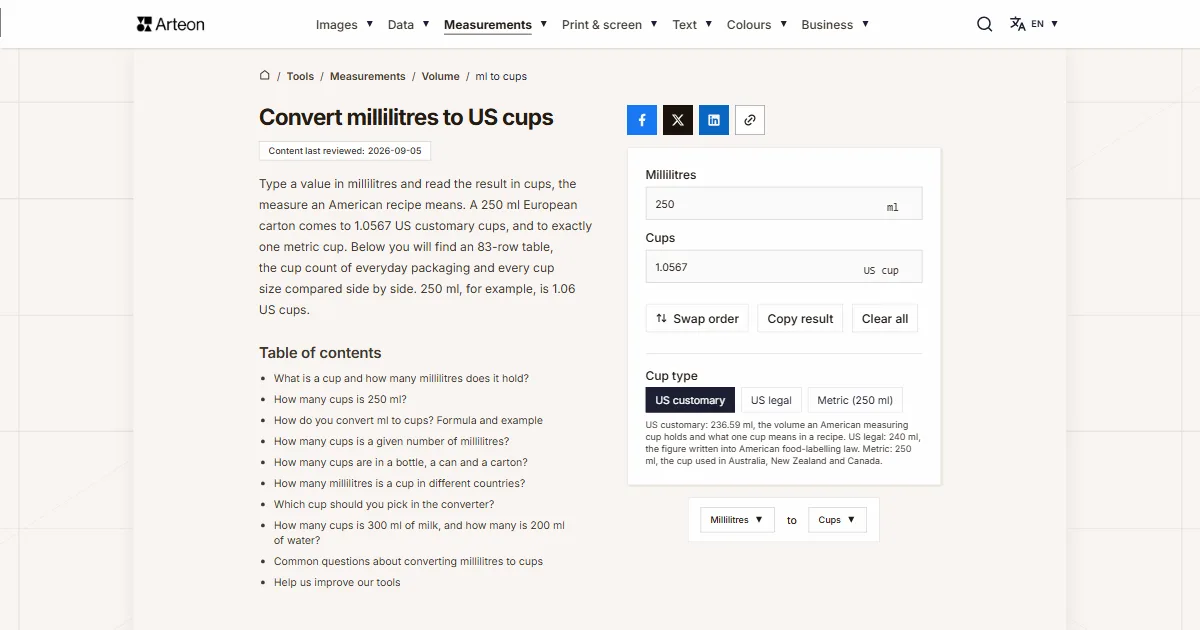
Type a value in millilitres and read the result in cups, the measure an American recipe means. A 250 ml European carton comes to 1.0567 US customary cups, and to exactly one metric cup. Below you will find an 83-row table, the cup count of everyday packaging and every cup size compared side by side. 250 ml, for example, is 1.06 US cups.
What is a cup and how many millilitres does it hold?
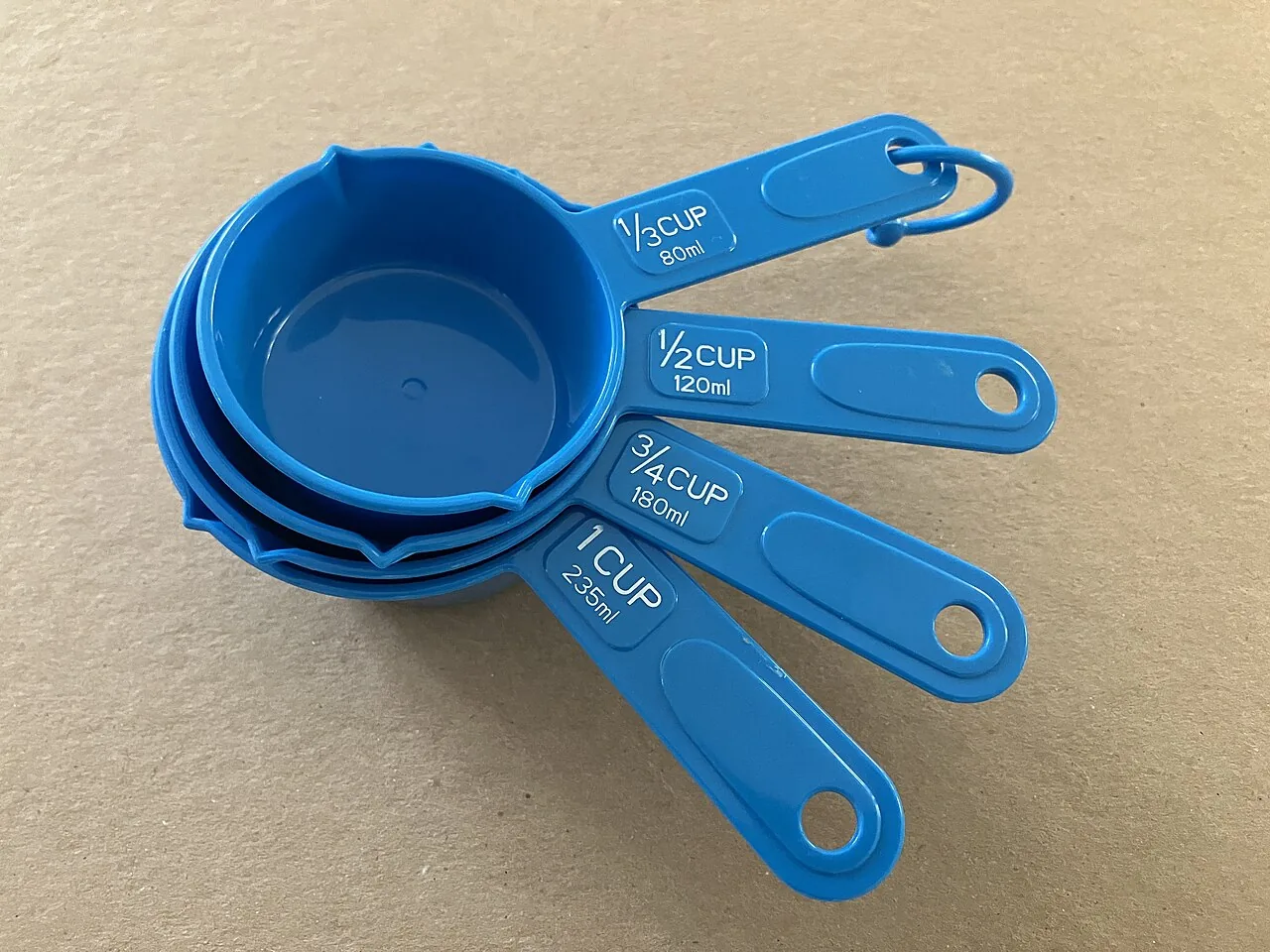
A cup is a unit of volume used in American cooking. Recipes give both liquids and dry goods in cups, and you measure them with a measuring cup of fixed capacity.
One name covers three capacities today and all three are in use. The US customary cup holds 236.59 millilitres, which is what a measuring cup sold in an American store actually contains. The legal cup holds exactly 240 millilitres, the figure written into federal food-labelling rules[1]. The metric cup holds exactly 250 millilitres and serves Australia, New Zealand and Canada.
British kitchens are the odd one out: they measure in grams, millilitres and fluid ounces, and a cup-based measuring set is a recent import there rather than a tradition[2].
You pick the measure with the Cup type switch under the converter fields. The US customary cup is the default, because that is what a recipe means when it says one cup.
How many cups is 250 ml?
Two hundred and fifty millilitres comes to 1.0567 US customary cups. In the metric measure the same volume gives exactly one cup, because the metric cup was defined as a quarter of a litre.
Three more figures come up constantly, and they are the ones worth keeping in mind. One hundred millilitres is 0.4227 of a US cup. Two hundred millilitres gives 0.8454. Five hundred millilitres, the size of a standard water bottle, comes to 2.1134 cups.
Metric packaging is where most of these questions start. European cartons, tins and bottles carry round millilitre figures, so a 250 ml carton of cream lands just past a full cup rather than on it.
When you need the calculation the other way round, the cups to millilitres converter handles it.
How do you convert ml to cups? Formula and example
Divide the number of millilitres by the capacity of the cup your recipe uses.
Formula: cups = millilitres ÷ 236.5882365 for the US customary cup. The divisor is 240 for the legal cup and 250 for the metric one.
Here is the arithmetic on a real figure. An American soda can holds 355 millilitres. Divided by 236.5882365 it comes to 1.5005 cups, so the can matches one and a half cups almost exactly.
The divisor follows from the definition of the gallon. A US cup is a sixteenth of a US gallon, and the gallon is exactly 231 cubic inches. An inch is exactly 2.54 centimetres, so the gallon holds 3,785.411784 millilitres. Divide that by sixteen and 236.5882365 millilitres is what remains.
For a rough figure in your head, work in metric cups: divide by a thousand and multiply by four. Half a litre gives two cups and a litre gives four.
Larger volumes are handled by the millilitres to litres converter, and values given in fluid ounces by the millilitres to fluid ounces converter.
How many cups is a given number of millilitres?
| Millilitres | US customary cup | US legal cup | Metric cup |
|---|---|---|---|
| 1 ml | 0.0042 | 0.0042 | 0.004 |
| 2 ml | 0.0085 | 0.0083 | 0.008 |
| 5 ml | 0.0211 | 0.0208 | 0.02 |
| 10 ml | 0.0423 | 0.0417 | 0.04 |
| 15 ml | 0.0634 | 0.0625 | 0.06 |
| 20 ml | 0.0845 | 0.0833 | 0.08 |
| 25 ml | 0.1057 | 0.1042 | 0.1 |
| 30 ml | 0.1268 | 0.125 | 0.12 |
| 35 ml | 0.1479 | 0.1458 | 0.14 |
| 40 ml | 0.1691 | 0.1667 | 0.16 |
| 45 ml | 0.1902 | 0.1875 | 0.18 |
| 50 ml | 0.2113 | 0.2083 | 0.2 |
| 60 ml | 0.2536 | 0.25 | 0.24 |
| 65 ml | 0.2747 | 0.2708 | 0.26 |
| 70 ml | 0.2959 | 0.2917 | 0.28 |
| 75 ml | 0.317 | 0.3125 | 0.3 |
| 80 ml | 0.3381 | 0.3333 | 0.32 |
| 85 ml | 0.3593 | 0.3542 | 0.34 |
| 90 ml | 0.3804 | 0.375 | 0.36 |
| 95 ml | 0.4015 | 0.3958 | 0.38 |
| 100 ml | 0.4227 | 0.4167 | 0.4 |
| 110 ml | 0.4649 | 0.4583 | 0.44 |
| 115 ml | 0.4861 | 0.4792 | 0.46 |
| 118 ml | 0.4988 | 0.4917 | 0.472 |
| 120 ml | 0.5072 | 0.5 | 0.48 |
| 125 ml | 0.5283 | 0.5208 | 0.5 |
| 130 ml | 0.5495 | 0.5417 | 0.52 |
| 135 ml | 0.5706 | 0.5625 | 0.54 |
| 140 ml | 0.5917 | 0.5833 | 0.56 |
| 148 ml | 0.6256 | 0.6167 | 0.592 |
| 150 ml | 0.634 | 0.625 | 0.6 |
| 160 ml | 0.6763 | 0.6667 | 0.64 |
| 165 ml | 0.6974 | 0.6875 | 0.66 |
| 170 ml | 0.7185 | 0.7083 | 0.68 |
| 175 ml | 0.7397 | 0.7292 | 0.7 |
| 180 ml | 0.7608 | 0.75 | 0.72 |
| 185 ml | 0.7819 | 0.7708 | 0.74 |
| 187 ml | 0.7904 | 0.7792 | 0.748 |
| 190 ml | 0.8031 | 0.7917 | 0.76 |
| 200 ml | 0.8454 | 0.8333 | 0.8 |
| 210 ml | 0.8876 | 0.875 | 0.84 |
| 220 ml | 0.9299 | 0.9167 | 0.88 |
| 225 ml | 0.951 | 0.9375 | 0.9 |
| 230 ml | 0.9722 | 0.9583 | 0.92 |
| 235 ml | 0.9933 | 0.9792 | 0.94 |
| 236 ml | 0.9975 | 0.9833 | 0.944 |
| 240 ml | 1.0144 | 1 | 0.96 |
| 250 ml | 1.0567 | 1.0417 | 1 |
| 260 ml | 1.099 | 1.0833 | 1.04 |
| 270 ml | 1.1412 | 1.125 | 1.08 |
| 280 ml | 1.1835 | 1.1667 | 1.12 |
| 290 ml | 1.2258 | 1.2083 | 1.16 |
| 300 ml | 1.268 | 1.25 | 1.2 |
| 310 ml | 1.3103 | 1.2917 | 1.24 |
| 320 ml | 1.3526 | 1.3333 | 1.28 |
| 330 ml | 1.3948 | 1.375 | 1.32 |
| 340 ml | 1.4371 | 1.4167 | 1.36 |
| 350 ml | 1.4794 | 1.4583 | 1.4 |
| 355 ml | 1.5005 | 1.4792 | 1.42 |
| 360 ml | 1.5216 | 1.5 | 1.44 |
| 370 ml | 1.5639 | 1.5417 | 1.48 |
| 375 ml | 1.585 | 1.5625 | 1.5 |
| 390 ml | 1.6484 | 1.625 | 1.56 |
| 400 ml | 1.6907 | 1.6667 | 1.6 |
| 420 ml | 1.7752 | 1.75 | 1.68 |
| 425 ml | 1.7964 | 1.7708 | 1.7 |
| 450 ml | 1.902 | 1.875 | 1.8 |
| 473 ml | 1.9993 | 1.9708 | 1.892 |
| 475 ml | 2.0077 | 1.9792 | 1.9 |
| 480 ml | 2.0288 | 2 | 1.92 |
| 500 ml | 2.1134 | 2.0833 | 2 |
| 540 ml | 2.2824 | 2.25 | 2.16 |
| 590 ml | 2.4938 | 2.4583 | 2.36 |
| 650 ml | 2.7474 | 2.7083 | 2.6 |
| 720 ml | 3.0433 | 3 | 2.88 |
| 750 ml | 3.1701 | 3.125 | 3 |
| 850 ml | 3.5927 | 3.5417 | 3.4 |
| 946 ml | 3.9985 | 3.9417 | 3.784 |
| 1,000 ml | 4.2268 | 4.1667 | 4 |
| 1,400 ml | 5.9175 | 5.8333 | 5.6 |
| 1,800 ml | 7.6082 | 7.5 | 7.2 |
| 2,500 ml | 10.5669 | 10.4167 | 10 |
| 4,000 ml | 16.907 | 16.6667 | 16 |
How many cups are in a bottle, a can and a carton?
| Capacity | US customary cup | Metric cup | Where you meet it |
|---|---|---|---|
| 118 ml | 0.4988 | 0.472 | A juice box, and half a cup in an American recipe |
| 148 ml | 0.6256 | 0.592 | A cup from a drip coffee maker, five fluid ounces |
| 180 ml | 0.7608 | 0.72 | The rice cup that ships with a rice cooker |
| 187 ml | 0.7904 | 0.748 | A piccolo, the smallest wine bottle |
| 200 ml | 0.8454 | 0.8 | A small juice carton, and the Japanese cup |
| 236 ml | 0.9975 | 0.944 | An American disposable cup marked eight ounces |
| 250 ml | 1.0567 | 1 | A European quarter-litre carton and the metric cup |
| 330 ml | 1.3948 | 1.32 | A European drinks can |
| 355 ml | 1.5005 | 1.42 | An American soda can, twelve fluid ounces |
| 375 ml | 1.585 | 1.5 | A half bottle of wine |
| 473 ml | 1.9993 | 1.892 | A US liquid pint, sixteen fluid ounces |
| 500 ml | 2.1134 | 2 | A standard water bottle |
| 568 ml | 2.4008 | 2.272 | An imperial pint of beer |
| 591 ml | 2.498 | 2.364 | An American twenty-ounce bottle |
| 700 ml | 2.9587 | 2.8 | A bottle of vodka or whisky |
| 720 ml | 3.0433 | 2.88 | A sake bottle, which is four gō |
| 750 ml | 3.1701 | 3 | A standard wine bottle |
| 946 ml | 3.9985 | 3.784 | A US quart, thirty-two fluid ounces |
| 1,000 ml | 4.2268 | 4 | A litre carton of milk or juice |
| 1,500 ml | 6.3401 | 6 | A magnum, a double wine bottle |
| 1,750 ml | 7.3968 | 7 | An American 1.75 litre spirits bottle |
How many millilitres is a cup in different countries?
| Type of cup | Millilitres | Where it applies | Where the figure comes from |
|---|---|---|---|
| US customary cup | 236.5882365 ml | United States: recipes and measuring sets | A sixteenth of a US gallon, which is eight fluid ounces |
| US legal cup | 240 ml | United States: Nutrition Facts panels | The figure written into 21 CFR 101.9 |
| Metric cup | 250 ml | Australia, New Zealand and Canada | A quarter of a litre |
| European quarter-litre carton | 250 ml | Continental Europe: packaging | The same quarter of a litre as the metric cup |
| Pre-metric Canadian cup | 227.3045 ml | Canada until the 1970s | Eight imperial fluid ounces, a twentieth of an imperial gallon |
| Japanese cup | 200 ml | Japan: modern recipes | A round figure adopted after metrication |
| Gō | 180.4 ml | Japan: rice and sake | Fixed by law at 2401/13310 of a litre in 1891 |
| Rice cooker cup | 180 ml | Rice cookers sold worldwide | The metric rounding of the gō |
| British cup of 1894 | 170.48 ml | Older British cookbooks | Six imperial fluid ounces |
| Drip coffee maker cup | 148 ml | Coffee makers and their carafes | Five fluid ounces per cup |
Which cup should you pick in the converter?
The switch under the fields offers three options, and the situations below cover practically everything you will run into.
An American recipe, food blog or cookbook: US customary
Recipes written in the United States mean the customary cup of 236.59 millilitres, and that is what a measuring cup sold there holds. The same measure governs the nested sets marked 1/4, 1/3, 1/2 and 1 cup.A figure read off a Nutrition Facts panel: US legal
Serving sizes on American packaging use the legal cup of 240 millilitres. The same rule rounds a tablespoon to 15 millilitres, a teaspoon to 5 millilitres and a fluid ounce to 30 millilitres[1].A recipe from Australia, New Zealand or Canada: metric
Countries that metricated after leaving British measures adopted a cup of exactly a quarter of a litre. An Australian tablespoon holds 20 millilitres rather than 15, so an Australian cup takes 12.5 tablespoons. An American recipe counts sixteen, because its tablespoon is smaller.A European product with a millilitre figure: metric
Cartons, tins and bottles sold across Europe carry round millilitre capacities, and a quarter-litre carton is exactly one metric cup. Setting the switch to metric turns the packaging figure straight into cups without a remainder.
How many cups is 300 ml of milk, and how many is 200 ml of water?
Three hundred millilitres of milk is 1.268 US customary cups. Two hundred millilitres of water gives 0.8454 of a cup.
Both figures come out of the same calculation, because a cup measures volume. A measuring cup filled to the same mark holds as much milk as water, juice or stock, so naming the liquid in the recipe leaves the conversion unchanged.
Flour and sugar fill the same volume too, while their weight depends on the density of the ingredient — which is why American baking recipes now print grams alongside cups.
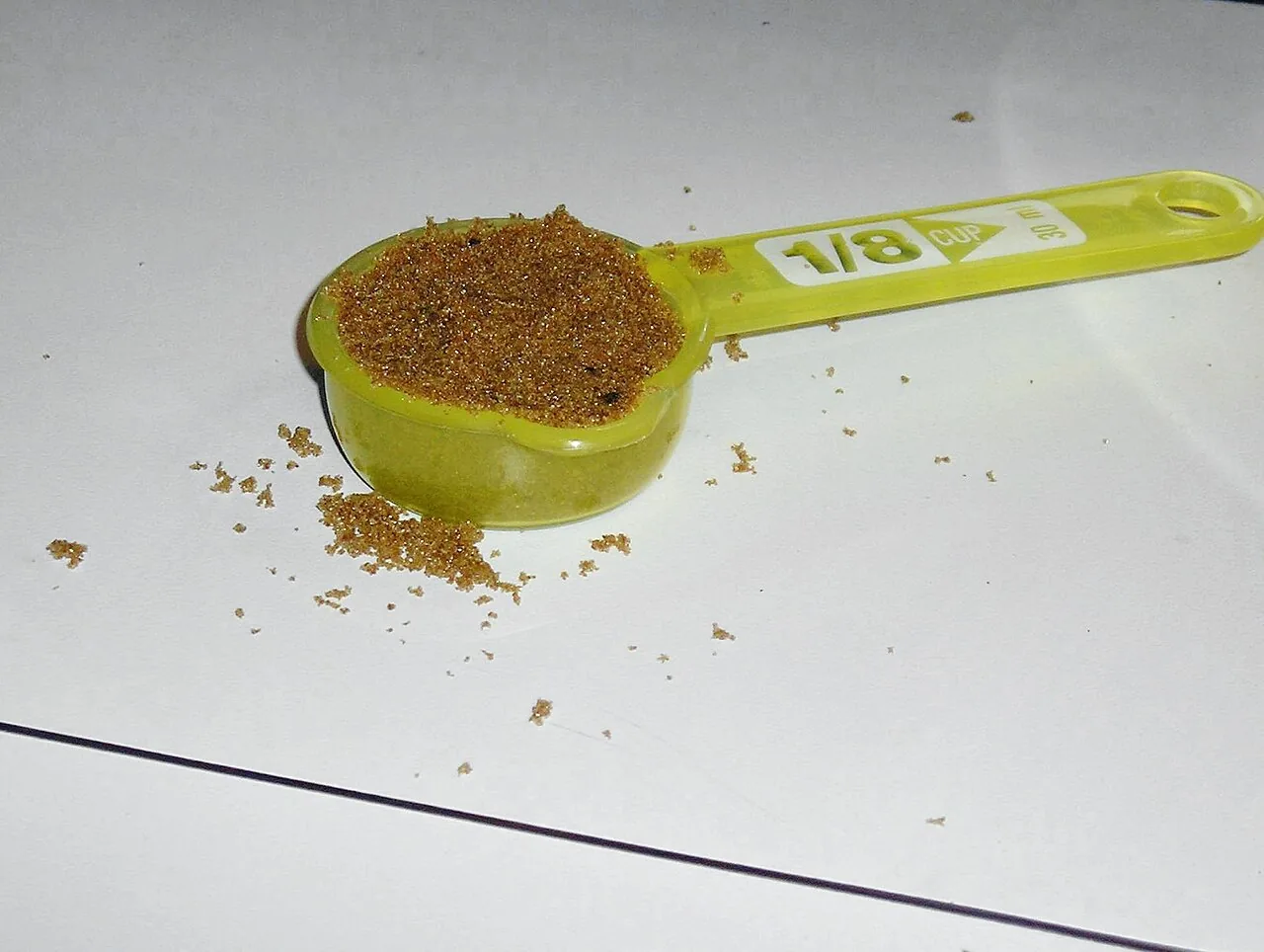
American kitchens keep two kinds of measuring cup at the same capacity. A dry cup is filled to the brim and levelled off with a straight edge, which suits flour and sugar. A liquid cup has a graduated scale and a pouring spout, and you read it at eye level from the bottom of the meniscus[4].

Convert Millilitres to other units
Sources
- 21 CFR 101.9 — Nutrition labeling of food — Legal Information Institute, Cornell Law School
- Cup (unit) — Wikipedia
- Ge (unit) — Wikipedia
- Measuring cup — Wikipedia
Every figure in the tables was computed from the unit definitions and checked arithmetically before publication. Historical values and the names of local units come from the sources listed above.
Content last reviewed: · written and checked by the Arteon team
Common questions about converting millilitres to cups
Is 250 ml one cup?
In the metric measure it is: a metric cup holds exactly 250 millilitres. In the US customary measure the same volume gives 1.0567 cups, because that cup holds 236.59 millilitres. The gap is 13.41 millilitres, roughly what a tablespoon holds.
Is a cup 200 or 250 ml?
Two hundred and fifty millilitres is the metric cup used in Australia, New Zealand and Canada. Two hundred millilitres is the Japanese cup, adopted there after metrication. An American recipe means a third figure, 236.59 millilitres, which its labels round to 240.
How many cups is 500 ml?
Five hundred millilitres is 2.1134 US customary cups. In the legal cup the same volume gives 2.0833. In the metric cup it lands on exactly two, because half a litre is two quarter-litres.
Is 100 ml half a cup?
One hundred millilitres is 0.4227 of a US customary cup, so it falls short of a half. Half a US cup is 118.29 millilitres, half a legal cup is 120 millilitres and half a metric cup is 125 millilitres.
Why does my coffee maker count cups differently?
Drip coffee makers count a cup as five fluid ounces, roughly 148 millilitres. A carafe sold as a twelve-cup model therefore fills with sixty fluid ounces of water, about 1.77 litres[2]. That works out at about 7.5 US customary cups.
How many millilitres is the cup that comes with a rice cooker?
One hundred and eighty millilitres, which is 0.7608 of a US customary cup. It is the metric rounding of the Japanese gō, fixed by law in 1891 at 2401/13310 of a litre, about 180.4 millilitres[3]. The cup used in modern Japanese recipes is a separate measure of exactly 200 millilitres.
How many fluid ounces are in a cup?
A US customary cup is eight fluid ounces, and that ratio is where its capacity comes from. One US fluid ounce is 29.5735 millilitres, so eight of them give 236.59 millilitres. The millilitres to fluid ounces converter handles both the US and the imperial ounce.
Will the converter field accept a fraction like 3/4?
Yes. The field reads plain fractions such as 3/4 and mixed numbers such as 2 1/2, so you can copy a value straight out of a recipe. A comma and a full stop both work as the decimal mark, so 2.5 and 2,5 give the same result.
Help us improve our tools
Got an idea for a new feature, found a bug or want to suggest another tool? Write to us — we reply within 24 hours.