Convert miles to meters
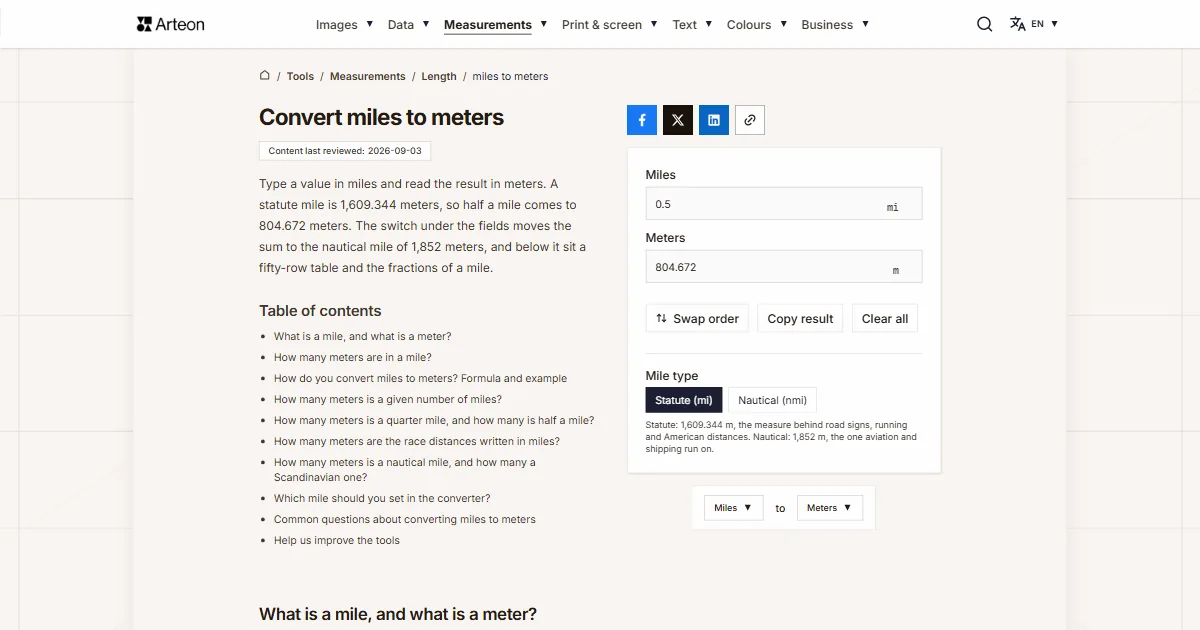
Type a value in miles and read the result in meters. A statute mile is 1,609.344 meters, so half a mile comes to 804.672 meters. The switch under the fields moves the sum to the nautical mile of 1,852 meters, and below it sit a fifty-row table and the fractions of a mile.
What is a mile, and what is a meter?
The mile takes its name from the Roman mille passus, a thousand paces of a marching legionary, and originally ran to about 1,479 meters[1]. The Roman sum was tidy, because that mile held a round 5,000 Roman feet.
The figure of 5,280 feet came later, from an English statute of the late sixteenth century. Parliament built the mile out of rods and furlongs, the units fields were measured with at the time, and the same distance comes to 1,760 yards[1].
The mile took its present value on 1 July 1959, when the English-speaking countries agreed on a single yard and pound. From that day it has been exactly 1,609.344 meters[2]. The number looks arbitrary, and it follows directly from the arithmetic of the units that came before it.
The meter on the other side of this conversion is a base unit of the SI (the International System of Units). Since 1983 its value has rested on the speed of light: a meter is the distance light travels in a vacuum in 1/299,792,458 of a second[3]. That is where the difference in character between the two measures comes from — the mile grew out of a human pace and the width of a field, while the meter grew out of measuring a physical phenomenon.
Alongside the statute mile, the nautical mile is also in daily use. It is exactly 1,852 meters and matches one minute of arc along a meridian[4]. Which mile you are looking at is settled by the field the number came from: a chart and a flight plan give distance in nautical miles, while a road sign and a race description give it in statute miles. The Mile type switch in the converter above moves the sum between the two.
How many meters are in a mile?
A statute mile is 1,609.344 meters, or roughly 1.6 kilometers. A nautical mile is 1,852 meters, which makes it fifteen percent longer than the statute one.
Beyond the full mile, three fractions come up more often than any others. A quarter mile is 402.336 meters. A half mile gives 804.672 meters. Three quarters of a mile is 1,207.008 meters.
Read the other way round, a hundred meters is 0.062137 miles and a thousand meters gives 0.621371 miles. Those are exactly the values the meters to miles converter works out.
The converter above shows the result while you type and takes both decimal values and simple fractions.
How do you convert miles to meters? Formula and example
The conversion rests on a single constant: a statute mile is 1,609.344 meters. To turn miles into meters, you multiply their number by that value.
The full formula: meters = miles × 1,609.344. The other way round: miles = meters ÷ 1,609.344.
Three figures come out of that multiplication more often than the rest. One mile is 1,609.344 meters. Five miles give 8,046.72 meters. Ten miles come to 16,093.44 meters, a little over sixteen kilometers.
Fractional values work the same way. A mile and a half, the distance of the American fitness run, gives 2,414.016 meters. Two point four miles, the swim leg of an Ironman triathlon, is 3,862.43 meters.
The nautical mile calls for a different multiplier, and that multiplier is 1,852. Five nautical miles then give a round 9,260 meters, and one nautical mile gives 1,852 meters. The Mile type switch in the converter makes that swap for you.
How many meters is a given number of miles?
| Miles | Meters (statute mile) | Meters (nautical mile) |
|---|---|---|
| 0.1 mi | 160.93 m | 185.2 m |
| 0.125 mi | 201.17 m | 231.5 m |
| 0.2 mi | 321.87 m | 370.4 m |
| 0.25 mi | 402.34 m | 463 m |
| 0.3 mi | 482.8 m | 555.6 m |
| 0.4 mi | 643.74 m | 740.8 m |
| 0.5 mi | 804.67 m | 926 m |
| 0.6 mi | 965.61 m | 1,111.2 m |
| 0.7 mi | 1,126.54 m | 1,296.4 m |
| 0.75 mi | 1,207.01 m | 1,389 m |
| 0.8 mi | 1,287.48 m | 1,481.6 m |
| 0.9 mi | 1,448.41 m | 1,666.8 m |
| 1 mi | 1,609.34 m | 1,852 m |
| 1.1 mi | 1,770.28 m | 2,037.2 m |
| 1.2 mi | 1,931.21 m | 2,222.4 m |
| 1.25 mi | 2,011.68 m | 2,315 m |
| 1.3 mi | 2,092.15 m | 2,407.6 m |
| 1.4 mi | 2,253.08 m | 2,592.8 m |
| 1.5 mi | 2,414.02 m | 2,778 m |
| 1.6 mi | 2,574.95 m | 2,963.2 m |
| 1.7 mi | 2,735.88 m | 3,148.4 m |
| 1.8 mi | 2,896.82 m | 3,333.6 m |
| 1.9 mi | 3,057.75 m | 3,518.8 m |
| 2 mi | 3,218.69 m | 3,704 m |
| 2.4 mi | 3,862.43 m | 4,444.8 m |
| 2.5 mi | 4,023.36 m | 4,630 m |
| 3 mi | 4,828.03 m | 5,556 m |
| 3.1 mi | 4,988.97 m | 5,741.2 m |
| 4 mi | 6,437.38 m | 7,408 m |
| 5 mi | 8,046.72 m | 9,260 m |
| 6 mi | 9,656.06 m | 11,112 m |
| 6.2 mi | 9,977.93 m | 11,482.4 m |
| 7 mi | 11,265.41 m | 12,964 m |
| 8 mi | 12,874.75 m | 14,816 m |
| 9 mi | 14,484.1 m | 16,668 m |
| 10 mi | 16,093.44 m | 18,520 m |
| 12 mi | 19,312.13 m | 22,224 m |
| 13 mi | 20,921.47 m | 24,076 m |
| 13.1 mi | 21,082.41 m | 24,261.2 m |
| 15 mi | 24,140.16 m | 27,780 m |
| 16 mi | 25,749.5 m | 29,632 m |
| 20 mi | 32,186.88 m | 37,040 m |
| 25 mi | 40,233.6 m | 46,300 m |
| 26.2 mi | 42,164.81 m | 48,522.4 m |
| 30 mi | 48,280.32 m | 55,560 m |
| 40 mi | 64,373.76 m | 74,080 m |
| 50 mi | 80,467.2 m | 92,600 m |
| 60 mi | 96,560.64 m | 111,120 m |
| 62 mi | 99,779.33 m | 114,824 m |
| 100 mi | 160,934.4 m | 185,200 m |
The 3.1 mi, 6.2 mi, 13.1 mi and 26.2 mi rows are the written forms of race distances that are metric in the original. The table below sets them against the metric distance. The same lengths given in kilometers are handled by the miles to kilometers converter.
How many meters is a quarter mile, and how many is half a mile?
| Part of a mile | Decimal form | Meters |
|---|---|---|
| One tenth of a mile | 0.1 mi | 160.934 m |
| One eighth of a mile (furlong) | 0.125 mi | 201.168 m |
| Quarter mile | 0.25 mi | 402.336 m |
| One third of a mile | 0.3333 mi | 536.448 m |
| Half mile | 0.5 mi | 804.672 m |
| Two thirds of a mile | 0.6667 mi | 1,072.896 m |
| Three quarters of a mile | 0.75 mi | 1,207.008 m |
| The full mile | 1 mi | 1,609.344 m |
The furlong is an eighth of a mile and runs to 660 feet, which is 201.168 meters. The unit is still in use in horse racing in the United Kingdom, Ireland, Canada and the United States. The quarter mile of 402.336 meters is the distance of an American drag race.
How many meters are the race distances written in miles?
| Distance | Written in miles | Meters from the conversion | Official distance | Difference |
|---|---|---|---|---|
| 5-kilometre race | 3.1 mi | 4,988.97 m | 5,000 m | 11.03 m |
| 10-kilometre race | 6.2 mi | 9,977.93 m | 10,000 m | 22.07 m |
| Half marathon | 13.1 mi | 21,082.41 m | 21,097.5 m | 15.09 m |
| Marathon | 26.2 mi | 42,164.81 m | 42,195 m | 30.19 m |
| 100-kilometre ultra | 62 mi | 99,779.33 m | 100,000 m | 220.67 m |
The official marathon distance is 42,195 meters. The written form of 26.2 miles converts to 42,164.81 meters, which is 30.19 meters less. The full distance in miles is 26.218757 miles, and you will find that value in the table on the meters to miles converter.
How many meters is a nautical mile, and how many a Scandinavian one?
| Kind of mile | Symbol | Meters | Where it applies |
|---|---|---|---|
| Statute mile | mi | 1,609.344 m | Roads, running and distances in the United States and the United Kingdom. Selected by default in the converter. |
| Nautical mile | nmi, NM, M | 1,852 m | Shipping and aviation worldwide. The second option in the converter. |
| Scandinavian mile | mil | 10,000 m | Sweden and Norway. Car mileage and distances between towns are quoted in it. |
| US survey mile | survey mi | 1,609.3472 m | American land surveying up to 31 December 2022. |
The Scandinavian mile is a round 10,000 meters, so a Swedish car listing showing 12 miles on the clock describes 120,000 meters. The US survey mile is 3.2 millimeters longer than the statute one and applied to American land surveying up to 31 December 2022. Since 1 January 2023 all surveying rests on the international foot[2]. The historical miles, the Roman one among them, are set out in the table on the meters to miles converter.
Which mile should you set in the converter?
The Mile type switch sits under both columns of the converter. The situations below cover practically everything you meet when the value in front of you is in miles.
Road sign and trail description: statute mile
American and British road signs, trail boards in national parks and route descriptions all give statute miles. Two miles to a viewpoint is 3,218.69 meters, and five miles is 8,046.72 meters. Both figures come out with the switch left as it is, on the Statute (mi) option.Running app result and race entry: statute mile
Apps set to US units record distance in statute miles. A mile and a half, the distance of the American fitness run, gives 2,414.016 meters. The marathon 26.2 miles comes to 42,164.81 meters. Sports watches usually keep unit settings in the app and on the device separately, so after changing them on your phone check the watch menu as well.Chart, flight plan and the letters NM: nautical mile
Air traffic control and shipping give distance in nautical miles, because one such mile matches a minute of arc along a meridian. The abbreviations that signal it in a source are NM, nmi and M. Click the Nautical (nmi) option then, and five nautical miles give a round 9,260 meters. Speed in this field is quoted in knots, and one knot is one nautical mile per hour.A whole column of values: spreadsheet
For a single number the field above is quicker, and for a whole column of distances a spreadsheet does it with one formula dragged down. In Excel the formula reads =CONVERT(A1,"mi","m"), and for the nautical mile you swap the first code for "Nmi"[5]. The formula =A1*1609.344 gives the same result and works in Google Sheets and LibreOffice Calc as well.
Sources
- Mile — Wikipedia
- U.S. Survey Foot: Revised Unit Conversion Factors — National Institute of Standards and Technology
- SI base unit: metre (m) — Bureau International des Poids et Mesures
- Nautical mile — Wikipedia
- CONVERT function — Microsoft
Every figure in the tables was computed from the unit definitions and checked arithmetically before publication. Historical values and the names of local units come from the sources listed above.
Content last reviewed: · written and checked by the Arteon team
Common questions about converting miles to meters
How many meters are in 1 mile?
A statute mile is exactly 1,609.344 meters. A nautical mile is 1,852 meters, fifteen percent more. In the converter you pick one or the other with the Mile type switch.
How many meters is half a mile?
Half a mile is 804.672 meters. A quarter mile gives 402.336 meters, and three quarters of a mile 1,207.008 meters.
How many meters is a quarter mile?
A quarter mile is 402.336 meters. An eighth of a mile, the furlong, gives 201.168 meters, and three eighths of a mile 603.504 meters.
How many meters is 5 miles and 10 miles?
Five miles is 8,046.72 meters. Ten miles gives 16,093.44 meters. A hundred miles comes to 160,934.4 meters, almost 161 kilometers.
How many meters is a nautical mile?
A nautical mile is exactly 1,852 meters, and its length matches one minute of arc along a meridian. Five nautical miles give a round 9,260 meters. In the converter you pick it with the Nautical (nmi) button.
How many meters is the marathon 26.2 miles?
The written form of 26.2 miles converts to 42,164.81 meters. The official marathon distance is 42,195 meters, which is 30.19 meters more, because in miles it measures 26.218757 miles.
Does the field accept fractions?
Yes. You can enter 0.25 or 0,25, and a simple fraction such as 1/4 as well. The result appears while you type, with no separate button to press. The other direction is handled by the meters to miles converter.
Help us improve the tools
Got an idea for a new feature, found a bug, or want to suggest another tool? Write to us — we reply within 24 hours.