Convert grams to milligrams
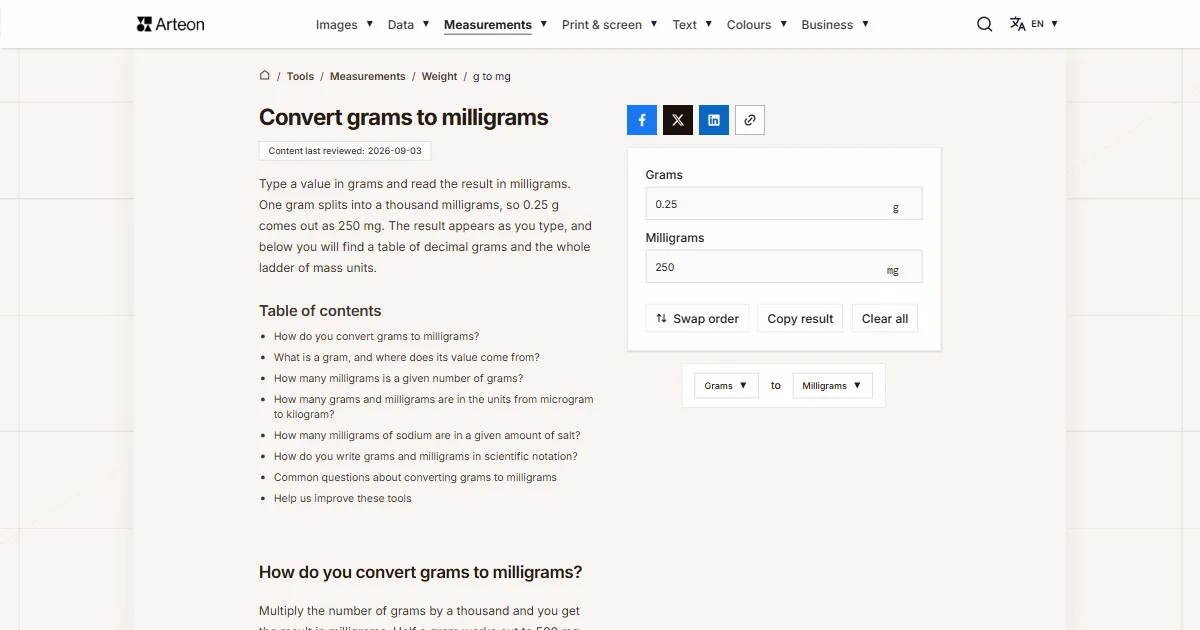
Type a value in grams and read the result in milligrams. One gram splits into a thousand milligrams, so 0.25 g comes out as 250 mg. The result appears as you type, and below you will find a table of decimal grams and every mass unit.
How do you convert grams to milligrams?
Multiply the number of grams by a thousand and you get the result in milligrams. Half a gram works out to 500 mg.
You can do the same in your head. Move the decimal point three places to the right and the number is ready. That turns 0.25 g into 250 mg, and 1.5 g into 1,500 mg.
Formula: milligrams = grams × 1,000
Four fractions of a gram come up most often, because that is how small masses are written in recipes and on labels. A tenth of a gram is 100 mg. A quarter of a gram is 250 mg. Half a gram is 500 mg. Three quarters of a gram is 750 mg.
The same thousand works in the other direction, only there it divides. Two thousand milligrams give 2 g, and the milligrams to grams converter will do that for you.
The result is exact down to the last digit, because a gram splits into a thousand milligrams by the definition of the prefix[1], and a thousand is a whole number.
For larger masses the grams to kilograms converter gives the same weight in kilograms, and at the deli counter the grams to ounces converter handles the swap to ounces.
What is a gram, and where does its value come from?
A gram is one thousandth of a kilogram. The SI base unit of mass is the kilogram[2], even though it is the name “gram” that all the prefixes attach to.
That rule keeps the whole notation tidy. The name of the base unit already carries the prefix “kilo”, so every further prefix goes to the gram. One millionth of a kilogram is called a milligram because of it, and is written 1 mg.
The kilogram itself has rested on a constant of nature since 2019. Its definition fixes the numerical value of the Planck constant at 6.62607015 × 10⁻³⁴ expressed in joule seconds[2]. Before that the standard was a platinum-iridium cylinder kept outside Paris.
The gram has been a base unit itself, only in a different system of measurement. In the CGS system, built on the centimeter, the gram and the second, it stood in the place of the unit of mass[1]. The kilogram took that role over when SI settled on the meter, the kilogram and the second.
How many milligrams is a given number of grams?
| Grams | Milligrams | Kilograms |
|---|---|---|
| 0.001 g | 1 mg | 0.000001 kg |
| 0.002 g | 2 mg | 0.000002 kg |
| 0.005 g | 5 mg | 0.000005 kg |
| 0.01 g | 10 mg | 0.00001 kg |
| 0.02 g | 20 mg | 0.00002 kg |
| 0.025 g | 25 mg | 0.000025 kg |
| 0.03 g | 30 mg | 0.00003 kg |
| 0.04 g | 40 mg | 0.00004 kg |
| 0.05 g | 50 mg | 0.00005 kg |
| 0.06 g | 60 mg | 0.00006 kg |
| 0.075 g | 75 mg | 0.000075 kg |
| 0.08 g | 80 mg | 0.00008 kg |
| 0.1 g | 100 mg | 0.0001 kg |
| 0.12 g | 120 mg | 0.00012 kg |
| 0.125 g | 125 mg | 0.000125 kg |
| 0.15 g | 150 mg | 0.00015 kg |
| 0.2 g | 200 mg | 0.0002 kg |
| 0.25 g | 250 mg | 0.00025 kg |
| 0.3 g | 300 mg | 0.0003 kg |
| 0.35 g | 350 mg | 0.00035 kg |
| 0.4 g | 400 mg | 0.0004 kg |
| 0.45 g | 450 mg | 0.00045 kg |
| 0.5 g | 500 mg | 0.0005 kg |
| 0.6 g | 600 mg | 0.0006 kg |
| 0.65 g | 650 mg | 0.00065 kg |
| 0.7 g | 700 mg | 0.0007 kg |
| 0.75 g | 750 mg | 0.00075 kg |
| 0.8 g | 800 mg | 0.0008 kg |
| 0.9 g | 900 mg | 0.0009 kg |
| 1 g | 1,000 mg | 0.001 kg |
| 1.1 g | 1,100 mg | 0.0011 kg |
| 1.2 g | 1,200 mg | 0.0012 kg |
| 1.25 g | 1,250 mg | 0.00125 kg |
| 1.5 g | 1,500 mg | 0.0015 kg |
| 1.6 g | 1,600 mg | 0.0016 kg |
| 1.8 g | 1,800 mg | 0.0018 kg |
| 2 g | 2,000 mg | 0.002 kg |
| 2.3 g | 2,300 mg | 0.0023 kg |
| 2.5 g | 2,500 mg | 0.0025 kg |
| 3 g | 3,000 mg | 0.003 kg |
| 3.5 g | 3,500 mg | 0.0035 kg |
| 4 g | 4,000 mg | 0.004 kg |
| 4.5 g | 4,500 mg | 0.0045 kg |
| 5 g | 5,000 mg | 0.005 kg |
| 6 g | 6,000 mg | 0.006 kg |
| 7 g | 7,000 mg | 0.007 kg |
| 7.5 g | 7,500 mg | 0.0075 kg |
| 8 g | 8,000 mg | 0.008 kg |
| 9 g | 9,000 mg | 0.009 kg |
| 10 g | 10,000 mg | 0.01 kg |
| 12 g | 12,000 mg | 0.012 kg |
| 15 g | 15,000 mg | 0.015 kg |
| 20 g | 20,000 mg | 0.02 kg |
| 25 g | 25,000 mg | 0.025 kg |
| 30 g | 30,000 mg | 0.03 kg |
| 35 g | 35,000 mg | 0.035 kg |
| 50 g | 50,000 mg | 0.05 kg |
| 65 g | 65,000 mg | 0.065 kg |
| 100 g | 100,000 mg | 0.1 kg |
| 250 g | 250,000 mg | 0.25 kg |
| 300 g | 300,000 mg | 0.3 kg |
| 500 g | 500,000 mg | 0.5 kg |
| 1,000 g | 1,000,000 mg | 1 kg |
Values below one hundredth of a gram are written in milligrams so the number does not open with a run of zeros. Five thousandths of a gram simply reads as 5 mg. American paper works the other way round and is sold by basis weight in pounds per ream rather than by grammage, so a sheet of Letter paper carries no gram figure on the wrapper.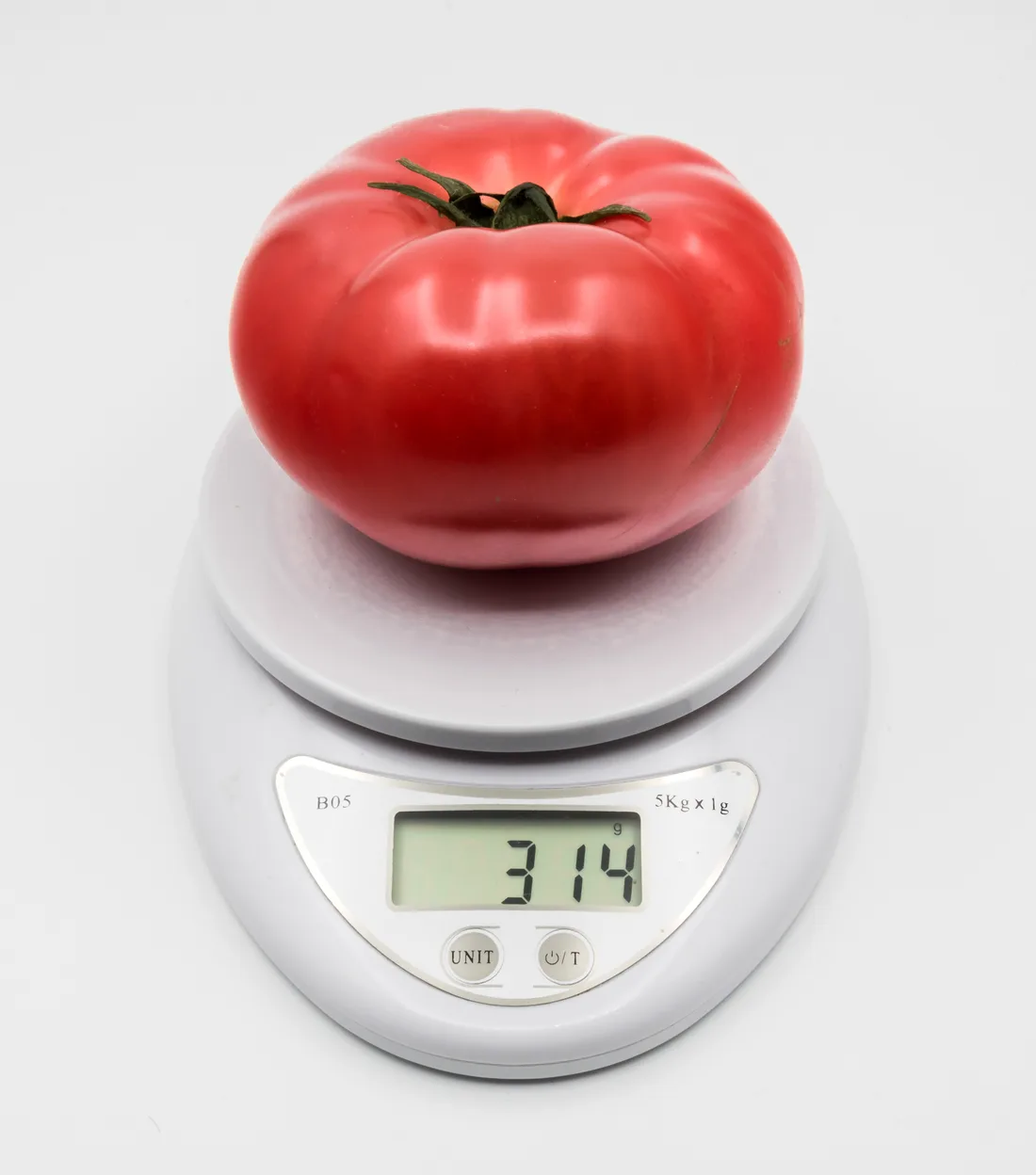
How many grams and milligrams are in the units from microgram to kilogram?
| Unit | Symbol | In grams | In milligrams |
|---|---|---|---|
| Microgram | µg | 0.000001 g | 0.001 mg |
| Milligram | mg | 0.001 g | 1 mg |
| Centigram | cg | 0.01 g | 10 mg |
| Decigram | dg | 0.1 g | 100 mg |
| Gram | g | 1 g | 1,000 mg |
| Decagram | dag | 10 g | 10,000 mg |
| Hectogram | hg | 100 g | 100,000 mg |
| Kilogram | kg | 1,000 g | 1,000,000 mg |
The centigram and the decigram survive mainly in school exercises and older tables; trade settled on the milligram and the gram instead. The decagram is a Central European habit rather than an English-speaking one, so the kilograms to grams converter works instead with the recipe and label amounts an English-speaking kitchen actually uses.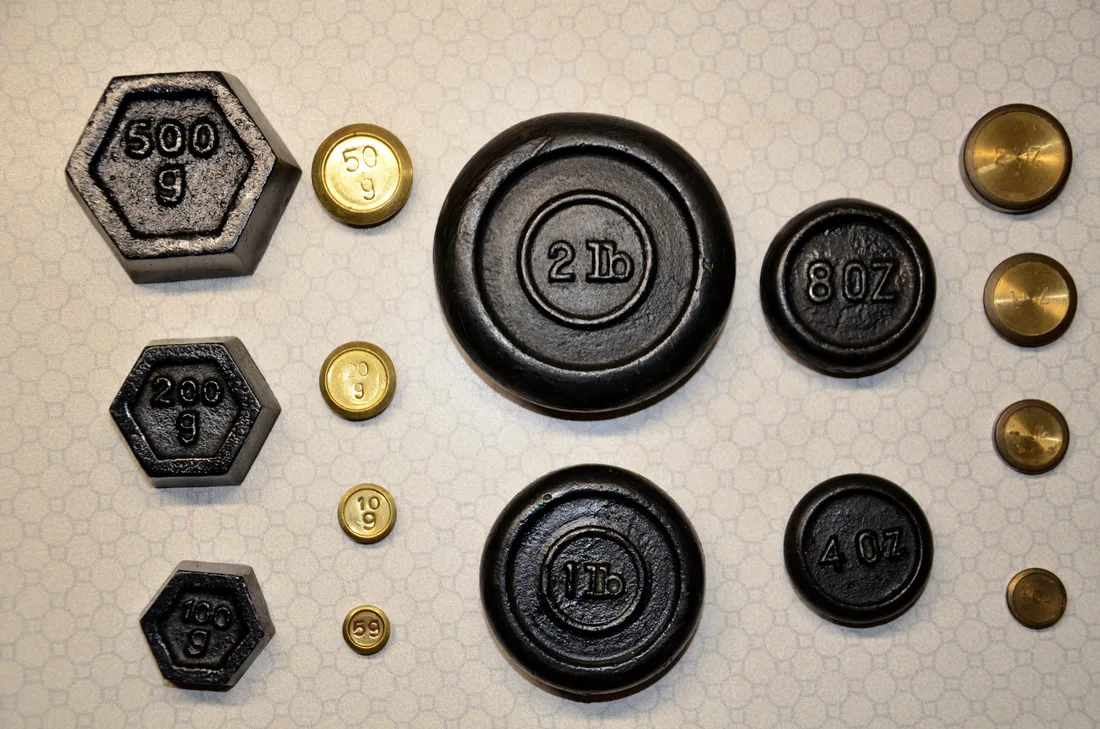
How many milligrams of sodium are in a given amount of salt?
| Salt | Milligrams of salt | Milligrams of sodium |
|---|---|---|
| 1 g | 1,000 mg | 400 mg |
| 1.5 g | 1,500 mg | 600 mg |
| 2 g | 2,000 mg | 800 mg |
| 2.5 g | 2,500 mg | 1,000 mg |
| 3 g | 3,000 mg | 1,200 mg |
| 4 g | 4,000 mg | 1,600 mg |
| 5 g | 5,000 mg | 2,000 mg |
| 6 g | 6,000 mg | 2,400 mg |
| 8 g | 8,000 mg | 3,200 mg |
| 10 g | 10,000 mg | 4,000 mg |
The row at five grams is the WHO threshold[5]. On the American side the FDA sets the Daily Value for sodium at 2,300 mg[6], which is 5.75 grams of salt, and prints it on the label in milligrams rather than in grams.
How do you write grams and milligrams in scientific notation?
Scientific notation writes a number as a multiplier times a power of ten, so units with prefixes fit into it directly. A milligram is 10⁻³ grams, because the prefix “milli” means exactly one thousandth[4].
Going from grams to milligrams the exponent is positive. One gram is 1 × 10³ mg. Half a gram is 5 × 10² mg. One hundredth of a gram is 1 × 10¹ mg, that is 10 mg.
The other way round the exponent drops below zero. One milligram is 1 × 10⁻³ g, a hundred milligrams are 1 × 10⁻¹ g, and one microgram is 1 × 10⁻⁶ g.
Spreadsheets and scientific calculators write the power with the letter E. The value 1E-03 means 0.001 there, so a cell showing 2.5E-03 g holds two and a half milligrams.
Sources
- Gram — Wikipedia
- Kilogram — Wikipedia
- ISO 216 — Wikipedia
- SI prefixes — Bureau International des Poids et Mesures (BIPM)
- Salt reduction — World Health Organization (WHO)
- Daily Value and Percent Daily Value on the Nutrition and Supplement Facts Labels — U.S. Food and Drug Administration
Every figure in the tables was computed from the unit definitions and checked arithmetically before publication. Historical values and the names of local units come from the sources listed above.
Content last reviewed: · written and checked by the Arteon team
Common questions about converting grams to milligrams
How many milligrams are in one gram?
A thousand. One gram is 1,000 mg, because the prefix “milli” means one thousandth. The same relation carries on upwards, so a kilogram holds a million milligrams.
How many milligrams is 0.5 g?
500 mg. You multiply 0.5 by 1,000, which in decimal notation comes down to moving the point three places to the right. The same route turns 0.25 g into 250 mg and 0.05 g into 50 mg.
Do you multiply or divide to convert grams to milligrams?
You multiply by a thousand. A milligram is smaller than a gram, so the same mass described in milligrams carries the larger number. The other way round, from milligrams to grams, you divide by a thousand.
How many milligrams is 0.25 g?
250 mg. A quarter of a gram is 250 milligrams, because a thousand divided by four gives 250.
Why do prefixes attach to the gram when the base unit is the kilogram?
Because the name of the base unit already contains the prefix “kilo”. SI therefore adds every further prefix to the name “gram”, which is how one millionth of a kilogram comes to be called a milligram and written mg.
How many milligrams of sodium are in a gram of salt?
400 mg. Salt is sodium multiplied by 2.5, so a gram of salt, that is 1,000 mg, divided by 2.5 gives 400 mg of sodium.
How do you write one gram in milligrams in scientific notation?
As 1 × 10³ mg. The exponent 3 means multiplication by a thousand. In a spreadsheet the same value reads 1E+03.
Help us improve these tools
Have an idea for a feature, found a bug or want to suggest another tool? Write to us — we reply within 24 hours.