Convert yards to feet
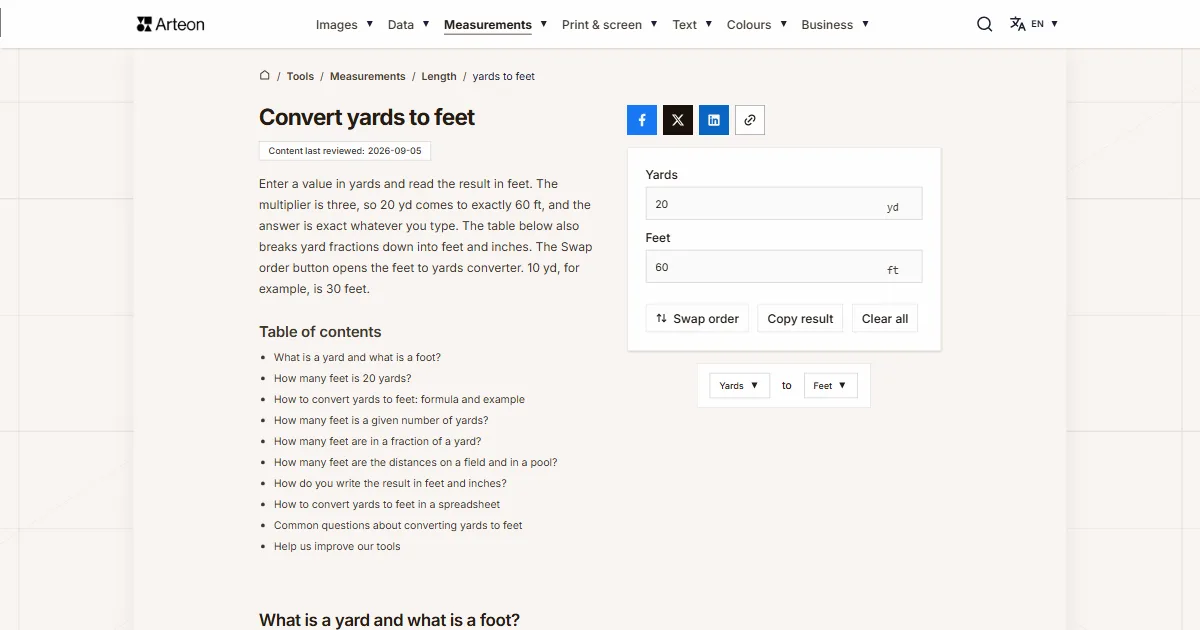
Enter a value in yards and read the result in feet. The multiplier is three, so 20 yd comes to exactly 60 ft, and the answer is exact whatever you type. The table below also breaks yard fractions down into feet and inches. The Swap order button opens the feet to yards converter. 10 yd, for example, is 30 feet.
What is a yard and what is a foot?
The yard is the working measure of length in the United States and the United Kingdom wherever a distance runs longer than a few paces and shorter than a mile. Field dimensions, cloth over a shop counter and the carry on a golf hole are all quoted in it.
The yard, written yd, is exactly 0.9144 metres[1], leaving it 8.56 cm short of a full metre. The ruler that matches it is the yardstick: a stick exactly one yard long, with the inch scale running to the very end.
The foot, written ft, is a third of a yard and comes to exactly 0.3048 metres[2]. It divides further into twelve inches, which puts thirty-six inches in a single yard.
The split into three parts has its roots in English law. The act written down around 1300, known as the Composition of Yards and Perches, built every measure up from a grain of barley: three grains made an inch, twelve inches a foot, and three feet a yard. Today's value comes from the agreement six English-speaking countries signed on 1 July 1959[3].
Cloth is the place the fraction still earns its keep. American and British shops sell fabric by the yard and cut it in halves and quarters, so an order reads 1/2 yd or 1 1/2 yd rather than a decimal — and the field at the top of this page takes those fractions exactly as written.
How many feet is 20 yards?
Twenty yards is exactly 60 feet. Nothing is left over, because multiplying by three always gives an exact value.
That is the substantial difference between the two directions of this conversion. Yards turned into feet give a number you can write down in full. Feet turned into yards give a repeating decimal for two out of every three whole values, because there you are dividing by three.
A few results come up more often than the rest. Ten yards is 30 feet, the distance a team has to cover for a new set of downs in American football. One hundred yards gives 300 feet, the length of the field between the goal lines. One thousand seven hundred and sixty yards is 5,280 feet, which is exactly one mile.
The table below sets out every value from one to thirty yards, and the converter at the top of the page will handle any other.
How to convert yards to feet: formula and example
Multiply the number of yards by three and you have the answer in feet. Seven yards works out at 21 feet.
Formula: feet = yards × 3
Going the other way, the multiplication becomes a division by that same three, and the feet to yards converter will do it for you.
The three here is exact and follows straight from the definitions of the two units. A yard is 0.9144 metres and a foot 0.3048 metres, so the first divides by the second exactly three times. The same ratio held in the now retired US survey system, where a yard ran to 3600/3937 metres and a foot to 1200/3937 metres. Your source can rest on either definition, then, and the number of feet comes out the same.
The input field also takes common fractions. Typing 1/2 reads as half a yard and returns 1.5 feet, and 1 1/2 reads as one and a half yards and returns 4.5 feet. Where cloth is sold in quarters and halves of a yard, you can enter the fraction exactly as the product description writes it.
For a metric answer, use the feet to metres converter. Anything smaller than a foot goes through the feet to inches converter, and distances longer than a field through the feet to miles converter.
How many feet is a given number of yards?
| Yards | Feet (ft) | Inches (in) | Metres (m) |
|---|---|---|---|
| 1 yd | 3 ft | 36 in | 0.9144 m |
| 2 yd | 6 ft | 72 in | 1.8288 m |
| 3 yd | 9 ft | 108 in | 2.7432 m |
| 4 yd | 12 ft | 144 in | 3.6576 m |
| 5 yd | 15 ft | 180 in | 4.572 m |
| 6 yd | 18 ft | 216 in | 5.4864 m |
| 7 yd | 21 ft | 252 in | 6.4008 m |
| 8 yd | 24 ft | 288 in | 7.3152 m |
| 9 yd | 27 ft | 324 in | 8.2296 m |
| 10 yd | 30 ft | 360 in | 9.144 m |
| 11 yd | 33 ft | 396 in | 10.0584 m |
| 12 yd | 36 ft | 432 in | 10.9728 m |
| 13 yd | 39 ft | 468 in | 11.8872 m |
| 14 yd | 42 ft | 504 in | 12.8016 m |
| 15 yd | 45 ft | 540 in | 13.716 m |
| 16 yd | 48 ft | 576 in | 14.6304 m |
| 17 yd | 51 ft | 612 in | 15.5448 m |
| 18 yd | 54 ft | 648 in | 16.4592 m |
| 19 yd | 57 ft | 684 in | 17.3736 m |
| 20 yd | 60 ft | 720 in | 18.288 m |
| 21 yd | 63 ft | 756 in | 19.2024 m |
| 22 yd | 66 ft | 792 in | 20.1168 m |
| 23 yd | 69 ft | 828 in | 21.0312 m |
| 24 yd | 72 ft | 864 in | 21.9456 m |
| 25 yd | 75 ft | 900 in | 22.86 m |
| 26 yd | 78 ft | 936 in | 23.7744 m |
| 27 yd | 81 ft | 972 in | 24.6888 m |
| 28 yd | 84 ft | 1,008 in | 25.6032 m |
| 30 yd | 90 ft | 1,080 in | 27.432 m |
| 32 yd | 96 ft | 1,152 in | 29.2608 m |
| 33 yd | 99 ft | 1,188 in | 30.1752 m |
| 35 yd | 105 ft | 1,260 in | 32.004 m |
| 40 yd | 120 ft | 1,440 in | 36.576 m |
| 45 yd | 135 ft | 1,620 in | 41.148 m |
| 50 yd | 150 ft | 1,800 in | 45.72 m |
| 53 yd | 159 ft | 1,908 in | 48.4632 m |
| 55 yd | 165 ft | 1,980 in | 50.292 m |
| 60 yd | 180 ft | 2,160 in | 54.864 m |
| 65 yd | 195 ft | 2,340 in | 59.436 m |
| 70 yd | 210 ft | 2,520 in | 64.008 m |
| 75 yd | 225 ft | 2,700 in | 68.58 m |
| 80 yd | 240 ft | 2,880 in | 73.152 m |
| 90 yd | 270 ft | 3,240 in | 82.296 m |
| 100 yd | 300 ft | 3,600 in | 91.44 m |
| 109 yd | 327 ft | 3,924 in | 99.6696 m |
| 110 yd | 330 ft | 3,960 in | 100.584 m |
| 120 yd | 360 ft | 4,320 in | 109.728 m |
| 125 yd | 375 ft | 4,500 in | 114.3 m |
| 130 yd | 390 ft | 4,680 in | 118.872 m |
| 140 yd | 420 ft | 5,040 in | 128.016 m |
| 150 yd | 450 ft | 5,400 in | 137.16 m |
| 160 yd | 480 ft | 5,760 in | 146.304 m |
| 175 yd | 525 ft | 6,300 in | 160.02 m |
| 180 yd | 540 ft | 6,480 in | 164.592 m |
| 200 yd | 600 ft | 7,200 in | 182.88 m |
| 220 yd | 660 ft | 7,920 in | 201.168 m |
| 250 yd | 750 ft | 9,000 in | 228.6 m |
| 300 yd | 900 ft | 10,800 in | 274.32 m |
| 350 yd | 1,050 ft | 12,600 in | 320.04 m |
| 400 yd | 1,200 ft | 14,400 in | 365.76 m |
| 500 yd | 1,500 ft | 18,000 in | 457.2 m |
| 600 yd | 1,800 ft | 21,600 in | 548.64 m |
| 700 yd | 2,100 ft | 25,200 in | 640.08 m |
| 800 yd | 2,400 ft | 28,800 in | 731.52 m |
| 1,000 yd | 3,000 ft | 36,000 in | 914.4 m |
| 1,500 yd | 4,500 ft | 54,000 in | 1,371.6 m |
| 1,760 yd | 5,280 ft | 63,360 in | 1,609.344 m |
How many feet are in a fraction of a yard?
| Fraction of a yard | Feet (ft) | Feet and inches | Centimetres (cm) |
|---|---|---|---|
| 1/8 of a yard | 0.375 ft | 4.5 in | 11.43 cm |
| 1/6 of a yard | 0.5 ft | 6 in | 15.24 cm |
| 1/4 of a yard | 0.75 ft | 9 in | 22.86 cm |
| 1/3 of a yard | 1 ft | 1 ft | 30.48 cm |
| 3/8 of a yard | 1.125 ft | 1 ft 1.5 in | 34.29 cm |
| 1/2 of a yard | 1.5 ft | 1 ft 6 in | 45.72 cm |
| 5/8 of a yard | 1.875 ft | 1 ft 10.5 in | 57.15 cm |
| 2/3 of a yard | 2 ft | 2 ft | 60.96 cm |
| 3/4 of a yard | 2.25 ft | 2 ft 3 in | 68.58 cm |
| 5/6 of a yard | 2.5 ft | 2 ft 6 in | 76.2 cm |
| 7/8 of a yard | 2.625 ft | 2 ft 7.5 in | 80.01 cm |
| 1 yard | 3 ft | 3 ft | 91.44 cm |
| 1 1/4 yards | 3.75 ft | 3 ft 9 in | 114.3 cm |
| 1 1/3 yards | 4 ft | 4 ft | 121.92 cm |
| 1 1/2 yards | 4.5 ft | 4 ft 6 in | 137.16 cm |
| 2 yards | 6 ft | 6 ft | 182.88 cm |
| 2 1/2 yards | 7.5 ft | 7 ft 6 in | 228.6 cm |
| 3 yards | 9 ft | 9 ft | 274.32 cm |
How many feet are the distances on a field and in a pool?
| Distance | Yards (yd) | Feet (ft) | Metres (m) |
|---|---|---|---|
| End zone, and the distance needed for a new set of downs | 10 yd | 30 ft | 9.14 m |
| Cricket pitch, length | 22 yd | 66 ft | 20.12 m |
| Short-course pool in the United States | 25 yd | 75 ft | 22.86 m |
| NFL Combine sprint | 40 yd | 120 ft | 36.58 m |
| Half the field, up to the 50-yard line | 50 yd | 150 ft | 45.72 m |
| American football field, between the goal lines | 100 yd | 300 ft | 91.44 m |
| American football field, including both end zones | 120 yd | 360 ft | 109.73 m |
| Furlong, an eighth of a mile | 220 yd | 660 ft | 201.17 m |
| Mile | 1,760 yd | 5,280 ft | 1,609.34 m |
How do you write the result in feet and inches?
Dimensions in the English-speaking world usually come in two units at once, as in 4 ft 6 in. The four steps below turn the converter's answer into that form. The worked example is one and a half yards.
Multiply the number of yards by three
One and a half yards multiplied by three gives 4.5 feet. That is the value the result field shows once you enter 1.5, or the fraction 1 1/2.Take the whole part as feet
From 4.5 you keep the four on its own. Those are the whole feet and the first half of the answer.Multiply the decimal part by twelve
That leaves 0.5 of a foot, and multiplying by twelve gives 6 inches. The multiplier is twelve because that is how many inches a foot holds.Put the two figures together
One and a half yards is 4 feet and 6 inches, written 4 ft 6 in. On an American drawing the same dimension appears with primes as 4′ 6″.
How to convert yards to feet in a spreadsheet
Type the number of yards into cell A1 and put the formula =A1*3 in the cell beside it. Excel, Google Sheets and LibreOffice Calc all read it the same way, and copying that cell down converts the whole column.
The built-in unit function gives the same answer: =CONVERT(A1,"yd","ft"). Unit codes go in quotation marks[7].
Swapping the target unit for "in" returns inches instead of feet. To split that answer, take the whole feet with =INT(A1*3) and the remaining inches with =MOD(A1*3,1)*12. For one and a half yards the first formula returns 4 and the second returns 6, that is four feet and six inches.
Convert other units to Feet
Convert Yards to other units
Sources
- Yard — Wikipedia
- Foot (unit) — Wikipedia
- International yard and pound — Wikipedia
- American football field — Wikipedia
- Cricket pitch — Wikipedia
- Swimming pool — Wikipedia
- CONVERT function — Microsoft
Every figure in the tables was computed from the unit definitions and checked arithmetically before publication. Historical values and the names of local units come from the sources listed above.
Content last reviewed: · written and checked by the Arteon team
Common questions about converting yards to feet
How many feet is 20 yards?
Twenty yards is exactly 60 feet. The working is 20 multiplied by 3. The same distance measures 720 inches and 18.29 metres.
Do you multiply or divide to turn yards into feet?
You multiply. A foot is shorter than a yard, so the same distance holds more feet than yards and the number has to grow. The multiplier is three. Dividing by three works the other way, turning feet into yards.
How many feet is a yard of fabric?
A yard of fabric is 3 feet, which is 36 inches and 91.44 centimetres. American and British shops also sell cloth in parts of a yard: half a yard is 1.5 feet and a quarter is 9 inches. The bolt width quoted in the description is set separately from the length you order.
How many feet is an American football field?
One hundred yards between the goal lines gives 300 feet. The whole field including both end zones runs to 120 yards, or 360 feet. The width is 160 feet, which is the one dimension of the field quoted in feet, though it converts to 53.33 yards.
What is 1.5 yards in feet and inches?
One and a half yards is 4.5 feet, that is 4 feet and 6 inches. In metric the same length measures 137.16 centimetres. The converter accepts both the decimal 1.5 and the fraction 1 1/2.
Does a British yard hold the same number of feet as an American one?
It does. Before 1959 the two values differed slightly: the American yard ran to 3600/3937 metres and the British one to about 0.91439841 metres. The agreement of 1 July 1959 set a common value of 0.9144 metres, and Britain wrote it into the Weights and Measures Act 1963, in force from 1 January 1964. The split into three feet was the same in both countries even before that.
How much shorter is a yard than a metre?
A yard is 0.9144 metres, so it falls 8.56 centimetres short of a full metre. Over one hundred yards that adds up to 8.56 metres, which is why an American field of 100 yards measures 91.44 metres.
Help us improve our tools
Have an idea for a new feature, spotted a bug or want to suggest another tool? Write to us — we reply within 24 hours.