Convert feet to miles
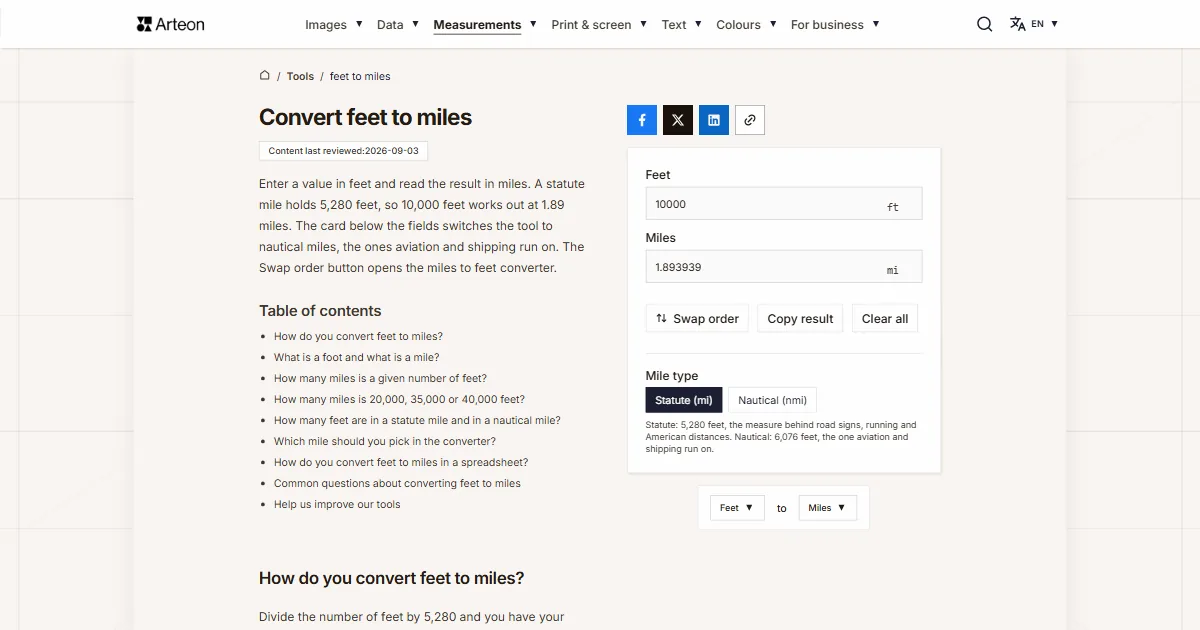
Enter a value in feet and read the result in miles. A statute mile holds 5,280 feet, so 10,000 feet works out at 1.89 miles. The card below the fields switches the tool to nautical miles, the ones aviation and shipping run on. The Swap order button opens the miles to feet converter.
How do you convert feet to miles?
Divide the number of feet by 5,280 and you have your answer in statute miles. Ten thousand feet works out at 1.89 miles.
A few results come up more often than the rest. Half a mile is 2,640 feet, and a quarter mile is 1,320 feet, which is the length every drag strip is built to.
Formula: miles = feet ÷ 5,280
Going the other way rests on the same number, with one change: you multiply by 5,280. Three miles come to 15,840 feet, and the miles to feet converter does the whole job for you.
Both numbers behind this sum are fixed and nobody rounds them. A statute mile measures exactly 1,609.344 metres[1], and a single foot measures 0.3048 metres[2].
There is a second mile alongside the statute one, and it is the mile aviation and shipping work in. The nautical mile is longer, because nobody ever laid it out across fields. Its length comes straight from the shape of the Earth: one nautical mile matches one minute of latitude.
Since 1929 it has been fixed at exactly 1,852 metres[3], which comes to 6,076.115 feet. The divisor becomes 6,076, and the gap against the statute mile reaches fifteen per cent.
One number shows it best. The same 20,000 feet is 3.79 statute miles and only 3.29 nautical miles.
You choose between the two in the card below the fields, and the result updates the moment you switch.
If you would rather see the answer in metric units, open the miles to metres, feet to metres or miles to kilometres converter.
What is a foot and what is a mile?
The foot is the length unit of the imperial system and it still runs everyday life in the United States and the United Kingdom. Since 1959 it has measured exactly 0.3048 metres, and it divides into twelve inches[2]. The name came from the length of a human foot. For centuries every country measured its own version, with values running from 25 to 33 centimetres, so an international agreement finally settled on a single figure.
The mile is a multiple of the foot and holds 5,280 of them[1]. The same distance can be written several ways, because a mile also holds 1,760 yards, or eight furlongs of 660 feet each. In metric units it comes to 1,609.344 metres.
Both units reach well past road signs. Aviation reports altitude in feet almost everywhere in the world, athletics still runs a mile on the track, and horse racing measures its distances in furlongs.
Ireland kept a longer mile of its own for centuries. The Irish mile measured 2,240 yards, which works out at 6,720 feet or roughly 1.27 statute miles[4]. The Weights and Measures Act of 1824 replaced it, although the Irish Post Office carried on using it until 1856.
How many miles is a given number of feet?
| Feet | Miles | Kilometres |
|---|---|---|
| 100 ft | 0.0189 mi | 0.03 km |
| 200 ft | 0.0379 mi | 0.061 km |
| 250 ft | 0.0473 mi | 0.076 km |
| 300 ft | 0.0568 mi | 0.091 km |
| 328 ft | 0.0621 mi | 0.1 km |
| 400 ft | 0.0758 mi | 0.122 km |
| 500 ft | 0.0947 mi | 0.152 km |
| 600 ft | 0.1136 mi | 0.183 km |
| 660 ft | 0.125 mi | 0.201 km |
| 700 ft | 0.1326 mi | 0.213 km |
| 800 ft | 0.1515 mi | 0.244 km |
| 900 ft | 0.1705 mi | 0.274 km |
| 984 ft | 0.1864 mi | 0.3 km |
| 1,000 ft | 0.1894 mi | 0.305 km |
| 1,100 ft | 0.2083 mi | 0.335 km |
| 1,200 ft | 0.2273 mi | 0.366 km |
| 1,320 ft | 0.25 mi | 0.402 km |
| 1,500 ft | 0.2841 mi | 0.457 km |
| 1,640 ft | 0.3106 mi | 0.5 km |
| 1,800 ft | 0.3409 mi | 0.549 km |
| 2,000 ft | 0.3788 mi | 0.61 km |
| 2,500 ft | 0.4735 mi | 0.762 km |
| 2,640 ft | 0.5 mi | 0.805 km |
| 3,000 ft | 0.5682 mi | 0.914 km |
| 3,280 ft | 0.6212 mi | 1 km |
| 3,500 ft | 0.6629 mi | 1.067 km |
| 4,000 ft | 0.7576 mi | 1.219 km |
| 4,500 ft | 0.8523 mi | 1.372 km |
| 5,000 ft | 0.947 mi | 1.524 km |
| 5,280 ft | 1 mi | 1.609 km |
| 6,000 ft | 1.1364 mi | 1.829 km |
| 7,000 ft | 1.3258 mi | 2.134 km |
| 8,000 ft | 1.5152 mi | 2.438 km |
| 9,000 ft | 1.7045 mi | 2.743 km |
| 10,000 ft | 1.8939 mi | 3.048 km |
| 12,000 ft | 2.2727 mi | 3.658 km |
| 15,000 ft | 2.8409 mi | 4.572 km |
| 20,000 ft | 3.7879 mi | 6.096 km |
| 25,000 ft | 4.7348 mi | 7.62 km |
| 30,000 ft | 5.6818 mi | 9.144 km |
| 35,000 ft | 6.6288 mi | 10.668 km |
| 40,000 ft | 7.5758 mi | 12.192 km |
| 50,000 ft | 9.4697 mi | 15.24 km |
Four rows in the table land on round metric values. A hundred metres falls at 328 feet, and three hundred metres at 984 feet. Half a kilometre is 1,640 feet, while a full kilometre is 3,280 feet. Three further rows land on fractions of a mile: an eighth of one is 660 feet, a quarter is 1,320 feet and a half is 2,640 feet.
How many miles is 20,000, 35,000 or 40,000 feet?
| Height or depth | Miles | Kilometres | What this figure is |
|---|---|---|---|
| 12,000 ft | 2.27 mi | 3.66 km | Flight level FL120 |
| 20,000 ft | 3.79 mi | 6.1 km | Flight level FL200 |
| 28,000 ft | 5.3 mi | 8.53 km | Flight level FL280, the lower end of the usual cruising band |
| 29,032 ft | 5.5 mi | 8.85 km | The summit of Mount Everest, as measured in 2020 |
| 33,000 ft | 6.25 mi | 10.06 km | Flight level FL330 |
| 35,000 ft | 6.63 mi | 10.67 km | Flight level FL350, the upper end of the usual cruising band |
| 35,876 ft | 6.79 mi | 10.94 km | The Challenger Deep, the deepest measured point of the ocean, surveyed in 2021 |
| 37,000 ft | 7.01 mi | 11.28 km | Flight level FL370 |
| 40,000 ft | 7.58 mi | 12.19 km | Flight level FL400 |
Everest stands at 8,848.86 metres according to the joint Nepalese and Chinese survey of 2020[6]. The Challenger Deep came out at 10,935 metres in the 2021 survey[7].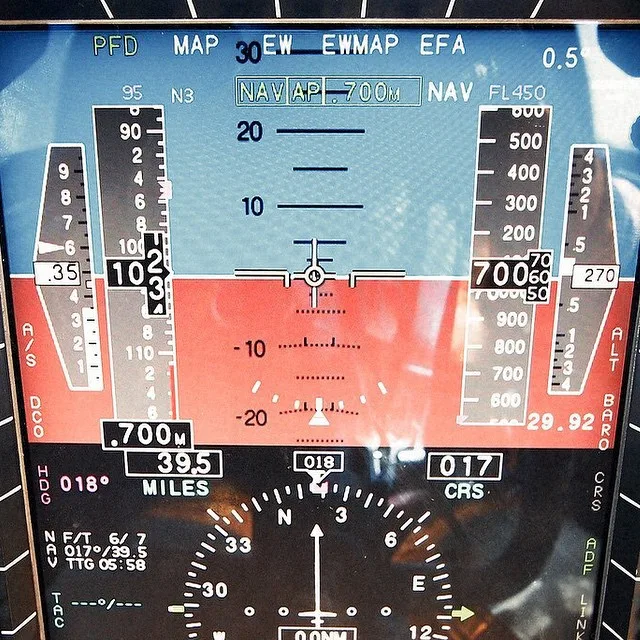
How many feet are in a statute mile and in a nautical mile?
| Kind of mile | Feet | Metres | Where you meet it |
|---|---|---|---|
| Statute mile | 5,280 | 1,609.344 | Roads, running and every American distance. Selected by default in the converter. |
| Nautical mile | 6,076.115 | 1,852 | Aviation and shipping worldwide. The second option in the converter. |
| Data mile | 6,000 | 1,828.8 | Radar work. |
| Admiralty mile | 6,080 | 1,853.184 | The Royal Navy, until 1970. |
| US survey mile | 5,280 survey feet | 1,609.3472 | American land surveying, until 31 December 2022. |
| Roman mile | 5,000 Roman feet | about 1,479 | Ancient Rome. A thousand double paces of a legionary, hence mille passus. |
| Irish mile | 6,720 | 2,048.256 | Ireland, until the nineteenth century. |
The survey foot measured 1200/3937 of a metre, which differs from the ordinary foot by two parts in a million. That sounds like nothing, but in land surveying it grows with distance: 3.2 millimetres over one mile and 32 centimetres over a hundred. Since 1 January 2023 only the international foot applies[2].
Which mile should you pick in the converter?
The switch below the fields offers two options, and the situations below cover very nearly everything you will run into.
Flight altitude, a summit, a building: statute mile
Anything measured straight up converts to statute miles. Flight level FL350 is 35,000 feet, which comes to 6.63 miles. The summit of Everest stands at 29,032 feet, giving exactly 5.5 miles above sea level.Distance to an airport or a ship's position: nautical mile
Air traffic control and shipping both quote distance in nautical miles, because one of them matches a minute of latitude. If your source shows NM or nmi, pick the Nautical (nmi) button.A road, a trail or a race distance: statute mile
Road signs in the States and in Britain, trail descriptions in the national parks and every running app work in statute miles. The same measure sits behind the drag racing quarter mile, which is 1,320 feet.Speed given in knots: nautical mile
A knot is one nautical mile per hour, so anything described in knots belongs to the same system. Aircraft and ship speeds are quoted in exactly this unit.
How do you convert feet to miles in a spreadsheet?
Put the number of feet in cell A1 and enter =A1/5280 in the cell next to it. Excel, Google Sheets and LibreOffice Calc all handle it the same way, and copying that cell downwards converts the whole column.
For nautical miles only the divisor changes, to =A1/6076.1155.
To round the answer to two decimal places, wrap the sum in the rounding function: =ROUND(A1/5280, 2).
Sources
- Mile — Wikipedia
- U.S. Survey Foot: Revised Unit Conversion Factors — NIST
- Nautical mile — Wikipedia
- Irish mile — Wikipedia
- Flight level — Wikipedia
- Mount Everest — Wikipedia
- Challenger Deep — Wikipedia
Every figure in the tables was computed from the unit definitions and checked arithmetically before publication. Historical values and the names of local units come from the sources listed above.
Content last reviewed: · written and checked by the Arteon team
Common questions about converting feet to miles
What does linear feet mean?
It means ordinary feet, measured along a single direction. Builders and installers use the phrase to separate the length of a material from its area. A hundred linear feet of fencing is a hundred feet, so the sum works the same way: 100 divided by 5,280 gives 0.019 miles.
What is the US survey foot and why has it gone?
The US survey foot measured 1200/3937 of a metre and had served American land surveying since 1866. It differed from the international foot by two parts in a million, which comes to 3.2 millimetres over one mile and 32 centimetres over a hundred. NIST retired it on 1 January 2023, so the international foot of 0.3048 metres now applies to every use.
Is a foot the same in the States and in Britain?
Yes. The 1959 agreement harmonised the yard and the pound across the English-speaking countries, and the foot was set at exactly 0.3048 metres. That same value holds in both countries and across the whole imperial system.
How many feet are in a metre and in a kilometre?
A metre holds 3.2808 feet and a kilometre holds 3,280.84 feet. That relationship explains the values in the table above that look arbitrary at first glance. A hundred metres lands on 328 feet, half a kilometre on 1,640 feet and a full kilometre on 3,280 feet. For metres on their own, use the feet to metres converter.
What is a furlong and how many feet does it have?
A furlong holds 660 feet, which is 220 yards or 201.168 metres. The name comes from the length of a furrow a team of oxen could plough without a rest, so the unit came straight off the farm. Eight furlongs make exactly one mile, and that is where the number 5,280 comes from. The furlong is still in official use in horse racing in Britain, Ireland, Canada and the United States.
Where does the 1,760 yards in a mile come from?
It is the same distance written in a different unit. A yard holds three feet, so 1,760 yards multiplies out to exactly 5,280 feet. One mile therefore has four equivalent descriptions, depending on what you happen to be measuring in: 5,280 feet, 1,760 yards, eight furlongs or eighty surveyor's chains.
Is flight altitude given in feet everywhere?
In most of the world, yes, and a flight level is written in hundreds of feet, so FL330 means 33,000 feet. China, Mongolia, Russia and several Commonwealth of Independent States countries work in metres, and there the same level is quoted as an altitude in metres.
Help us improve our tools
Have an idea for a new feature, found a bug, or want to suggest another tool? Write to us — we reply within 24 hours.