Convert centimeters to meters
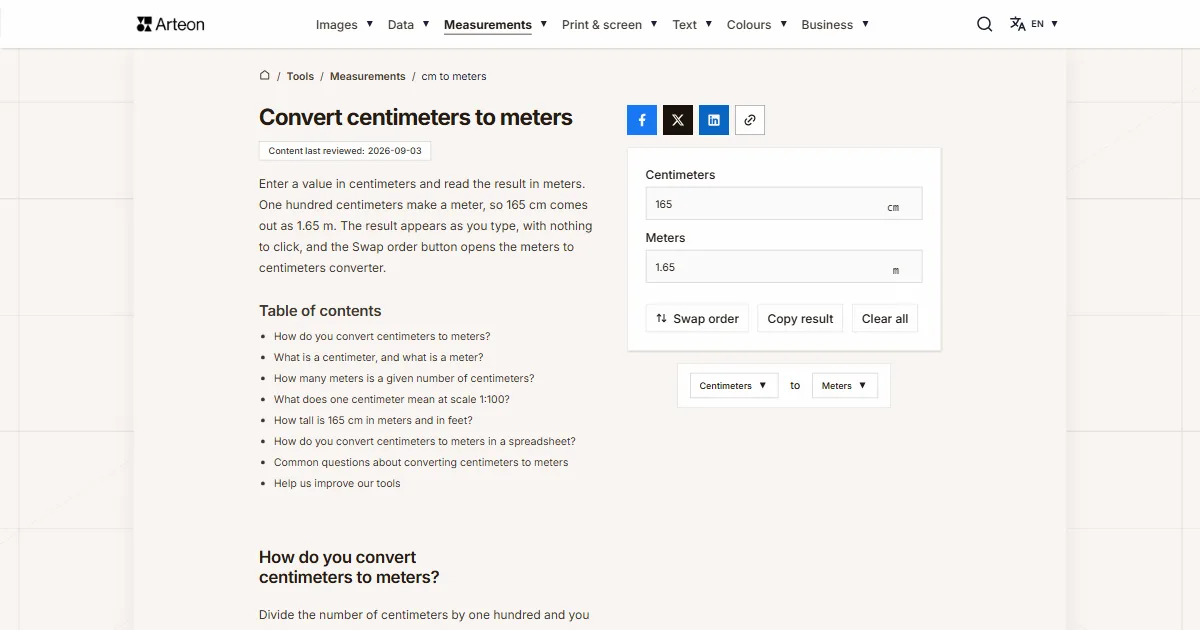
Enter a value in centimeters and read the result in meters. One hundred centimeters make a meter, so 165 cm comes out as 1.65 m. The result appears as you type, with nothing to click, and the Swap order button opens the meters to centimeters converter.
How do you convert centimeters to meters?
Divide the number of centimeters by one hundred and you have the answer in meters. One hundred and sixty-five centimeters works out at 1.65 meters.
The same sum works in your head, with no long division. Move the decimal point two places to the left and the number is ready. That turns 325 cm into 3.25 m, and 40 cm into 0.4 m.
Formula: meters = centimeters ÷ 100
Three results come up more often than the rest, because they describe everyday sizes. Fifty centimeters is half a meter. One hundred and fifty centimeters is a meter and a half. Two hundred and fifty centimeters gives two and a half meters.
Going the other way uses the same hundred, this time as a multiplier. Two meters comes to 200 cm, and the meters to centimeters converter will do the whole sum for you.
The conversion is exact down to the last digit. A centimeter is one hundredth of a meter by definition[1], so the hundred on the right of the formula is an exact number.
For finer work, the centimeters to millimeters converter gives the same measurement one step down. If your figure came in inches, the inches to centimeters converter takes it from there.
What is a centimeter, and what is a meter?
A centimeter is one hundredth of a meter, and the name says so outright: the prefix centi- stands for a factor of one hundredth[1]. One centimeter is roughly the width of an adult fingernail, and it divides again into ten millimeters.
The meter is the SI base unit of length, which makes it the reference point every other metric length is built from. Since 2019 its length has come from the speed of light: the meter is defined by fixing the speed of light in vacuum at 299,792,458 meters per second, with the second itself defined by the caesium frequency[2].
The centimeter once held the same rank, in a different system. In the CGS system, built on the centimeter, the gram and the second, it was the base unit of length — the role the meter now plays in SI[1].
In practice both units share one tool. A tape measure carries a centimeter scale, while room sizes get written down in meters, so every measurement ends with a conversion from one to the other.
How many meters is a given number of centimeters?
| Centimeters | Meters | Millimeters |
|---|---|---|
| 1 cm | 0.01 m | 10 mm |
| 2 cm | 0.02 m | 20 mm |
| 3 cm | 0.03 m | 30 mm |
| 4 cm | 0.04 m | 40 mm |
| 5 cm | 0.05 m | 50 mm |
| 6 cm | 0.06 m | 60 mm |
| 7 cm | 0.07 m | 70 mm |
| 8 cm | 0.08 m | 80 mm |
| 9 cm | 0.09 m | 90 mm |
| 10 cm | 0.1 m | 100 mm |
| 12 cm | 0.12 m | 120 mm |
| 15 cm | 0.15 m | 150 mm |
| 20 cm | 0.2 m | 200 mm |
| 25 cm | 0.25 m | 250 mm |
| 30 cm | 0.3 m | 300 mm |
| 35 cm | 0.35 m | 350 mm |
| 40 cm | 0.4 m | 400 mm |
| 45 cm | 0.45 m | 450 mm |
| 50 cm | 0.5 m | 500 mm |
| 60 cm | 0.6 m | 600 mm |
| 70 cm | 0.7 m | 700 mm |
| 75 cm | 0.75 m | 750 mm |
| 80 cm | 0.8 m | 800 mm |
| 90 cm | 0.9 m | 900 mm |
| 100 cm | 1 m | 1,000 mm |
| 110 cm | 1.1 m | 1,100 mm |
| 120 cm | 1.2 m | 1,200 mm |
| 125 cm | 1.25 m | 1,250 mm |
| 130 cm | 1.3 m | 1,300 mm |
| 140 cm | 1.4 m | 1,400 mm |
| 150 cm | 1.5 m | 1,500 mm |
| 152 cm | 1.52 m | 1,520 mm |
| 155 cm | 1.55 m | 1,550 mm |
| 156 cm | 1.56 m | 1,560 mm |
| 160 cm | 1.6 m | 1,600 mm |
| 163 cm | 1.63 m | 1,630 mm |
| 165 cm | 1.65 m | 1,650 mm |
| 167 cm | 1.67 m | 1,670 mm |
| 170 cm | 1.7 m | 1,700 mm |
| 175 cm | 1.75 m | 1,750 mm |
| 180 cm | 1.8 m | 1,800 mm |
| 183 cm | 1.83 m | 1,830 mm |
| 185 cm | 1.85 m | 1,850 mm |
| 190 cm | 1.9 m | 1,900 mm |
| 195 cm | 1.95 m | 1,950 mm |
| 200 cm | 2 m | 2,000 mm |
| 220 cm | 2.2 m | 2,200 mm |
| 240 cm | 2.4 m | 2,400 mm |
| 250 cm | 2.5 m | 2,500 mm |
| 300 cm | 3 m | 3,000 mm |
| 350 cm | 3.5 m | 3,500 mm |
| 400 cm | 4 m | 4,000 mm |
| 450 cm | 4.5 m | 4,500 mm |
| 500 cm | 5 m | 5,000 mm |
| 600 cm | 6 m | 6,000 mm |
| 700 cm | 7 m | 7,000 mm |
| 800 cm | 8 m | 8,000 mm |
| 900 cm | 9 m | 9,000 mm |
| 1,000 cm | 10 m | 10,000 mm |
| 1,200 cm | 12 m | 12,000 mm |
| 1,500 cm | 15 m | 15,000 mm |
| 2,000 cm | 20 m | 20,000 mm |
| 3,000 cm | 30 m | 30,000 mm |
The rows from 150 to 200 cm cover the range adult height falls into: 165 cm is written as 1.65 m, and 180 cm as 1.8 m. The highlighted hundredth row is the point where centimeters turn into a full meter.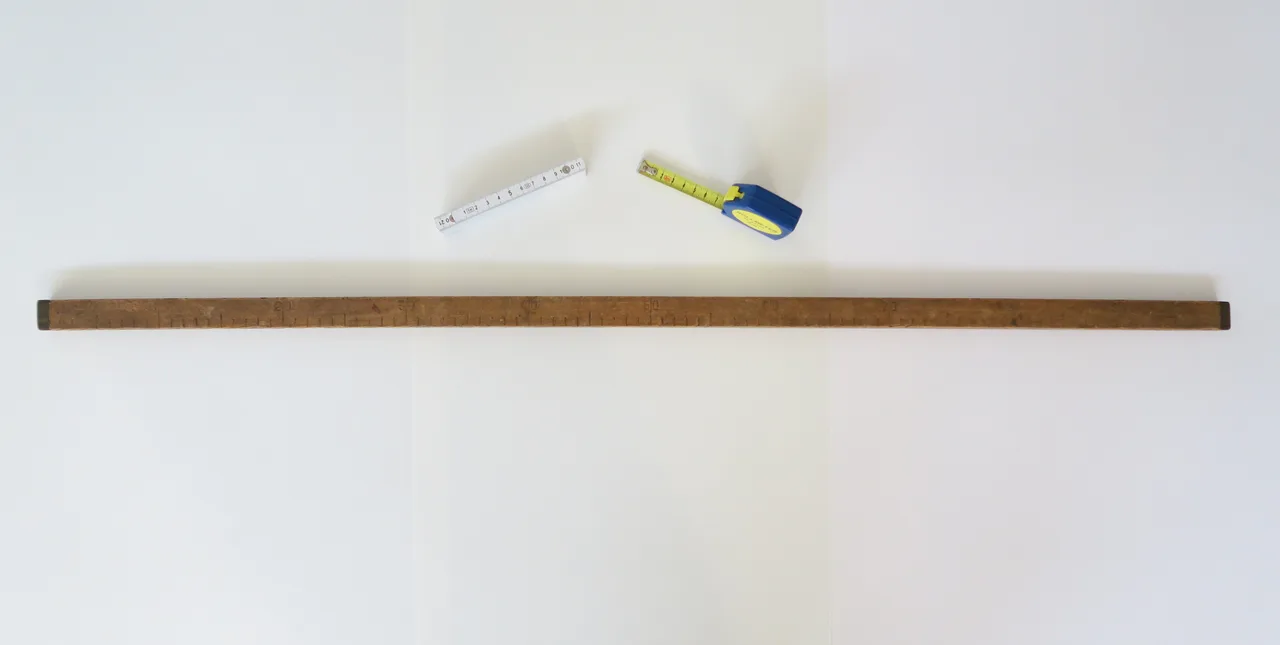
What does one centimeter mean at scale 1:100?
| Drawing scale | One centimeter on the drawing | One meter in real life | Where you meet it |
|---|---|---|---|
| 1:20 | 20 cm | 5 cm | Construction details and sections through structural parts |
| 1:50 | 50 cm | 2 cm | Apartment plans and interior layouts |
| 1:100 | 1 m | 1 cm | Floor plans and sections in an architectural drawing set |
| 1:200 | 2 m | 5 mm | Plans of large buildings |
| 1:500 | 5 m | 2 mm | Site plans |
| 1:1000 | 10 m | 1 mm | Site plans for linear projects such as roads and pipelines |
Scale rulers in Britain and other metric countries are marked with plain ratios such as 1:50 and 1:100, with the unit stated separately[4]. American drawings work the other way round and give inches to the foot, so a quarter-inch-to-the-foot drawing is the ratio 1:48 and a one-inch-to-the-foot drawing is 1:12[4]. That difference is the reason a set of drawings from a US office rarely carries a round metric ratio.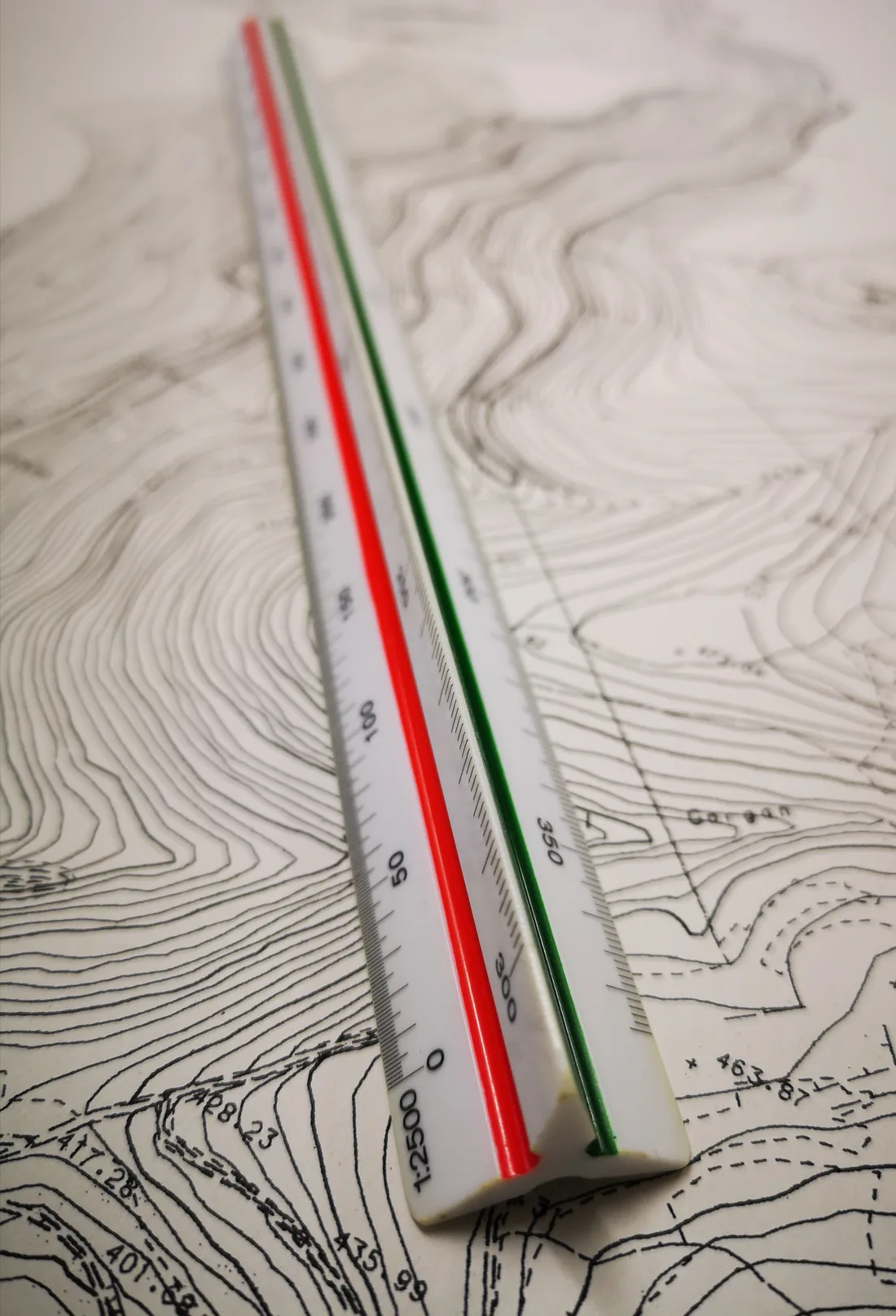
How tall is 165 cm in meters and in feet?
| Height | Meters | Feet and inches |
|---|---|---|
| 150 cm | 1.5 m | 4 ft 11 in |
| 155 cm | 1.55 m | 5 ft 1 in |
| 158 cm | 1.58 m | 5 ft 2 in |
| 160 cm | 1.6 m | 5 ft 3 in |
| 163 cm | 1.63 m | 5 ft 4 in |
| 165 cm | 1.65 m | 5 ft 5 in |
| 168 cm | 1.68 m | 5 ft 6 in |
| 170 cm | 1.7 m | 5 ft 7 in |
| 173 cm | 1.73 m | 5 ft 8 in |
| 175 cm | 1.75 m | 5 ft 9 in |
| 178 cm | 1.78 m | 5 ft 10 in |
| 180 cm | 1.8 m | 5 ft 11 in |
| 183 cm | 1.83 m | 6 ft 0 in |
| 185 cm | 1.85 m | 6 ft 1 in |
| 188 cm | 1.88 m | 6 ft 2 in |
| 190 cm | 1.9 m | 6 ft 3 in |
| 195 cm | 1.95 m | 6 ft 5 in |
| 200 cm | 2 m | 6 ft 7 in |
The exact figures come from the definition of the inch, which has been fixed at 2.54 cm since 1959. That makes a foot 30.48 cm, so 183 cm lands almost exactly on six feet. For a value outside this range, use the centimeters to inches converter.
How do you convert centimeters to meters in a spreadsheet?
Put the number of centimeters in cell A1 and enter =A1/100 in the cell next to it. Excel, Google Sheets and LibreOffice Calc all handle it the same way, and copying that cell down converts the whole column.
The built-in unit function gives the same answer: =CONVERT(A1,"cm","m"). Unit codes go in quotation marks, and the function also accepts metric prefixes, so "mm" and "km" work in the same place[5].
To round the answer to two decimal places, wrap the sum in the rounding function: =ROUND(A1/100,2). In a spreadsheet set to a language other than English, both function names are translated and the comma between arguments becomes a semicolon.
Sources
- Centimetre — Wikipedia
- Metre — Wikipedia
- Scale (ratio) — Wikipedia
- Architect's scale — Wikipedia
- CONVERT function — Microsoft
Every figure in the tables was computed from the unit definitions and checked arithmetically before publication. Historical values and the names of local units come from the sources listed above.
Content last reviewed: · written and checked by the Arteon team
Common questions about converting centimeters to meters
Is 100 centimeters really one meter?
Yes. A meter divides into one hundred equal centimeters, and that number is the same in every country and every application. One thousand is the number of millimeters in a meter, so the two figures describe the same length on two different scales.
How do you convert centimeters to meters in your head?
Move the decimal point two places to the left. That turns 750 cm into 7.5 m. It turns 8 cm into 0.08 m, where you fill the missing places with zeros. When the figure has no decimal point, write one at the end first and then move it.
How many square centimeters are in a square meter?
Ten thousand. A square meter measures area rather than length, so the conversion factor is squared: one hundred times one hundred gives 10,000 cm². The same rule applies one step up for volume, where a cubic meter holds a million cubic centimeters.
How do you write a centimeter in scientific notation?
One centimeter is 1 × 10⁻² m, because the prefix centi- stands for exactly that power of ten[1]. The notation earns its keep in physics and chemistry, where every length is reduced to meters before the calculation starts.
Is the centimeter part of the SI system?
Yes, as a submultiple of the meter formed with the prefix centi-. The base unit of the system is the meter itself, and every step below it — the decimeter, the centimeter and the millimeter — takes its length from there.
How many centimeters are in an inch, and why is it not a round number?
An inch is exactly 2.54 cm, which is 0.0254 m. The figure is exact because since 1959 the inch has been defined in terms of centimeters: the English-speaking countries signed a common agreement that year and tied the inch to the metric system. The inches to centimeters converter handles the rest.
Why does the United States teach centimeters at school but use inches everywhere else?
Metric units are part of the science curriculum, so homework and lab work come in centimeters and meters, while shop shelves, road signs and building plans stay in inches and feet. That split is why so many searches pair the two systems: the figure arrives in one and has to be reported in the other.
Help us improve our tools
Got an idea for a new feature, found a bug or want to suggest another tool? Write to us — we reply within 24 hours.