Convert millimetres to feet
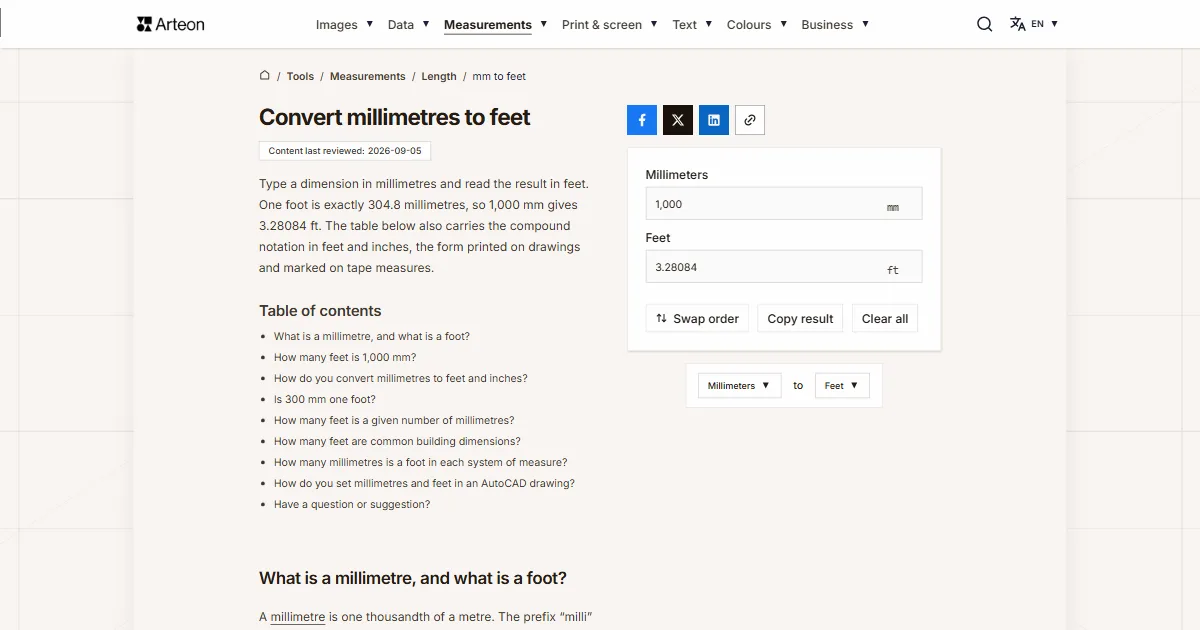
Type a dimension in millimetres and read the result in feet. One foot is exactly 304.8 millimetres, so 1,000 mm gives 3.28084 ft. The table below also carries the compound notation in feet and inches, the form printed on drawings and marked on tape measures.
What is a millimetre, and what is a foot?
A millimetre is one thousandth of a metre. The prefix “milli” carries a multiplier of one thousandth throughout the SI system, so a metre holds a thousand millimetres and a centimetre holds ten[1]. It is the unit every metric engineering drawing uses for its dimensions, because whole millimetres keep the numbers free of decimal points.
The foot (ft) measures exactly 304.8 millimetres. That figure comes from the International Yard and Pound Agreement of 1959, signed by the United States, the United Kingdom, Canada, Australia, New Zealand and South Africa[2]. Before it, each of those countries measured with a slightly different foot, so the same number on two drawings described two different lengths.
One foot divides into twelve inches, and three feet make one yard. That division is where the compound notation comes from: full feet first, then the remainder written in inches.
How many feet is 1,000 mm?
One thousand millimetres is 3.28084 feet. Written the way a tape measure is marked, that is 3 feet and 3 3/8 inches.
The same division gives the two figures asked about most often after that one. Five hundred millimetres comes to 1.64042 feet. Two thousand millimetres works out at 6.56168 feet.
Going the other way, a whole foot lands only on multiples of 304.8 mm. Five feet is exactly 1,524 mm and ten feet is exactly 3,048 mm — the only two rows in the main table on this page where the feet column shows a whole number.
Three feet, or one yard, falls on 914.4 mm. That is why the figure 914 mm turns up in catalogues and drawings that started life in imperial units: it is a yard rounded to the nearest millimetre.
How do you convert millimetres to feet and inches?
Divide the millimetres by 304.8:
feet = millimetres ÷ 304.8
The same sum can be written as a multiplication by 0.00328084, the number of feet in one millimetre. Both routes give an identical answer. Division is the one worth keeping in mind, because 304.8 comes back when you convert the other way and one number then covers both directions.
Worked example: 1,800 ÷ 304.8 = 5.905512 feet.
The compound notation comes out of the fractional part of that answer. The whole number, 5, is the full feet. Multiply the remainder 0.905512 by twelve and you get 10.866 inches. Round the inches to the nearest sixteenth, the finest graduation on a tape measure, and that becomes 10 7/8 inches. The full notation reads 5 ft 10 7/8 in.
For a result in inches alone, divide the millimetres by 25.4 instead — the job done by the millimetres to inches converter. The opposite direction, feet into millimetres, is handled by the feet to millimetres converter.
Is 300 mm one foot?
Three hundred millimetres is 0.984252 feet, or 11 13/16 inches. It falls 4.8 millimetres short of a full foot.
The two figures sit that close together for a reason written into a standard. Dimensional coordination in building is set out in ISO 2848, whose current edition was approved in April 1984[3]. The standard builds every dimension on a basic module written as M, which measures 100 mm in the metric version and 4 inches, or 101.6 mm, in the imperial one. Larger dimensions are assembled from multiples of that module, and 3M is the multiple reached for most often.
Metric 3M is 300 mm. Imperial 3M is 12 inches, which is 304.8 mm. Both modules do the same job in a design, and their lengths differ by 4.8 mm — which is exactly where the question comes from.
Across a single module that gap is invisible. Across ten modules it grows to 48 mm. Across thirty, the length of a wall nine metres long, it reaches 144 mm. That is why a dimension off a drawing gets divided by 304.8: rounding to 300 adds 4.8 mm at every module and after a dozen metres the difference is one you can see on site.
How many feet is a given number of millimetres?
| Millimetres | Feet | Feet and inches |
|---|---|---|
| 1 mm | 0.003281 ft | 0 1/16 in |
| 5 mm | 0.016404 ft | 0 3/16 in |
| 6 mm | 0.019685 ft | 0 1/4 in |
| 10 mm | 0.032808 ft | 0 3/8 in |
| 15 mm | 0.049213 ft | 0 9/16 in |
| 20 mm | 0.065617 ft | 0 13/16 in |
| 25 mm | 0.082021 ft | 1 in |
| 30 mm | 0.098425 ft | 1 3/16 in |
| 40 mm | 0.131234 ft | 1 9/16 in |
| 50 mm | 0.164042 ft | 1 15/16 in |
| 60 mm | 0.19685 ft | 2 3/8 in |
| 70 mm | 0.229659 ft | 2 3/4 in |
| 75 mm | 0.246063 ft | 2 15/16 in |
| 80 mm | 0.262467 ft | 3 1/8 in |
| 90 mm | 0.295276 ft | 3 9/16 in |
| 100 mm | 0.328084 ft | 3 15/16 in |
| 120 mm | 0.393701 ft | 4 3/4 in |
| 150 mm | 0.492126 ft | 5 7/8 in |
| 160 mm | 0.524934 ft | 6 5/16 in |
| 180 mm | 0.590551 ft | 7 1/16 in |
| 200 mm | 0.656168 ft | 7 7/8 in |
| 250 mm | 0.82021 ft | 9 13/16 in |
| 300 mm | 0.984252 ft | 11 13/16 in |
| 305 mm | 1.000656 ft | 1 ft 0 in |
| 350 mm | 1.148294 ft | 1 ft 1 3/4 in |
| 400 mm | 1.312336 ft | 1 ft 3 3/4 in |
| 450 mm | 1.476378 ft | 1 ft 5 11/16 in |
| 500 mm | 1.64042 ft | 1 ft 7 11/16 in |
| 550 mm | 1.804462 ft | 1 ft 9 5/8 in |
| 600 mm | 1.968504 ft | 1 ft 11 5/8 in |
| 610 mm | 2.001312 ft | 2 ft 0 in |
| 650 mm | 2.132546 ft | 2 ft 1 9/16 in |
| 700 mm | 2.296588 ft | 2 ft 3 9/16 in |
| 750 mm | 2.46063 ft | 2 ft 5 1/2 in |
| 760 mm | 2.493438 ft | 2 ft 5 15/16 in |
| 800 mm | 2.624672 ft | 2 ft 7 1/2 in |
| 850 mm | 2.788714 ft | 2 ft 9 7/16 in |
| 900 mm | 2.952756 ft | 2 ft 11 7/16 in |
| 914 mm | 2.998688 ft | 3 ft 0 in |
| 950 mm | 3.116798 ft | 3 ft 1 3/8 in |
| 1,000 mm | 3.28084 ft | 3 ft 3 3/8 in |
| 1,100 mm | 3.608924 ft | 3 ft 7 5/16 in |
| 1,200 mm | 3.937008 ft | 3 ft 11 1/4 in |
| 1,220 mm | 4.002625 ft | 4 ft 0 1/16 in |
| 1,250 mm | 4.10105 ft | 4 ft 1 3/16 in |
| 1,300 mm | 4.265092 ft | 4 ft 3 3/16 in |
| 1,400 mm | 4.593176 ft | 4 ft 7 1/8 in |
| 1,500 mm | 4.92126 ft | 4 ft 11 1/16 in |
| 1,524 mm | 5 ft | 5 ft 0 in |
| 1,600 mm | 5.249344 ft | 5 ft 3 in |
| 1,700 mm | 5.577428 ft | 5 ft 6 15/16 in |
| 1,800 mm | 5.905512 ft | 5 ft 10 7/8 in |
| 1,900 mm | 6.233596 ft | 6 ft 2 13/16 in |
| 2,000 mm | 6.56168 ft | 6 ft 6 3/4 in |
| 2,100 mm | 6.889764 ft | 6 ft 10 11/16 in |
| 2,200 mm | 7.217848 ft | 7 ft 2 5/8 in |
| 2,300 mm | 7.545932 ft | 7 ft 6 9/16 in |
| 2,400 mm | 7.874016 ft | 7 ft 10 1/2 in |
| 2,438 mm | 7.998688 ft | 8 ft 0 in |
| 2,440 mm | 8.005249 ft | 8 ft 0 1/16 in |
| 2,500 mm | 8.2021 ft | 8 ft 2 7/16 in |
| 2,600 mm | 8.530184 ft | 8 ft 6 3/8 in |
| 2,700 mm | 8.858268 ft | 8 ft 10 5/16 in |
| 2,800 mm | 9.186352 ft | 9 ft 2 1/4 in |
| 2,900 mm | 9.514436 ft | 9 ft 6 3/16 in |
| 3,000 mm | 9.84252 ft | 9 ft 10 1/8 in |
| 3,048 mm | 10 ft | 10 ft 0 in |
| 3,200 mm | 10.498688 ft | 10 ft 6 in |
| 3,500 mm | 11.48294 ft | 11 ft 5 13/16 in |
| 3,600 mm | 11.811024 ft | 11 ft 9 3/4 in |
| 4,000 mm | 13.12336 ft | 13 ft 1 1/2 in |
| 4,500 mm | 14.76378 ft | 14 ft 9 3/16 in |
| 5,000 mm | 16.404199 ft | 16 ft 4 7/8 in |
| 6,000 mm | 19.685039 ft | 19 ft 8 1/4 in |
| 6,058 mm | 19.875328 ft | 19 ft 10 1/2 in |
| 7,000 mm | 22.965879 ft | 22 ft 11 9/16 in |
| 8,000 mm | 26.246719 ft | 26 ft 2 15/16 in |
| 10,000 mm | 32.808399 ft | 32 ft 9 11/16 in |
How many feet are common building dimensions?
| Dimension | Millimetres | Feet | Feet and inches |
|---|---|---|---|
| The 3M module from ISO 2848 | 300 mm | 0.984252 ft | 11 13/16 in |
| Plasterboard sheet, width | 1,200 mm | 3.937008 ft | 3 ft 11 1/4 in |
| Sheet good in the 4 ft format, width | 1,219.2 mm | 4 ft | 4 ft 0 in |
| Sheet good in the 8 ft format, length | 2,438.4 mm | 8 ft | 8 ft 0 in |
| Continental European sheet, width | 1,250 mm | 4.10105 ft | 4 ft 1 3/16 in |
| Continental European sheet, length | 2,500 mm | 8.2021 ft | 8 ft 2 7/16 in |
| Standard internal door in England and Wales, width | 762 mm | 2.5 ft | 2 ft 6 in |
| Standard internal door in England and Wales, height | 1,981 mm | 6.499344 ft | 6 ft 6 in |
| Standard internal door in Scotland, width | 726 mm | 2.38189 ft | 2 ft 4 9/16 in |
| Standard internal door in Scotland, height | 2,040 mm | 6.692913 ft | 6 ft 8 5/16 in |
How many millimetres is a foot in each system of measure?
| Kind of foot | Millimetres | Where and when it applied |
|---|---|---|
| International foot | 304.8 mm | In force since 1959 across the whole inch-pound system |
| US survey foot | 304.8006096 mm | American land surveying from 1893 to 2022 |
| Pre-1959 British imperial foot | 304.799 mm | The United Kingdom until the 1959 agreement |
| Indian survey foot | 304.7996 mm | Indian land surveying |
| Cape foot | 314.858 mm | Land surveying in South Africa before metrication |
| Roman pes | 295.7 mm | The Roman Empire |
| Pes Drusianus | 334 mm | The Roman provinces north of the Alps |
How do you set millimetres and feet in an AutoCAD drawing?
An AutoCAD drawing stores bare numbers and leaves the unit to a document setting. That is why the same file can show two different dimensions to two people. The steps below describe AutoCAD 2027, released on 25 March 2026.
Find out what one drawing unit means
Type UNITS at the command line to open the Drawing Units dialog[6]. The field under Insertion scale states the real length of one drawing unit. That setting is stored in the INSUNITS system variable, which takes the value 1 for inches, 2 for feet, 4 for millimetres and 5 for centimetres[7]. Whether the dimension 1200 on the drawing means 1,200 millimetres or 1,200 inches follows from that number.Set the unit you want to work in
In the same dialog, the Length section governs how dimensions are displayed, and Insertion scale governs the unit of the file itself. The first decides what you see on screen and type at the keyboard. The second decides the scale at which an inserted block or external reference arrives.Rescale the geometry when you change systems
Changing the unit settings alters how dimensions are written and read, while objects already on the drawing keep the numbers they had. The -DWGUNITS command converts a whole file, working through a series of prompts and offering to match INSUNITS to the new unit along the way. The other route is to scale the selected objects by 25.4 when moving from inches to millimetres.Convert a single dimension here
For one figure off a drawing, rather than a change to the whole file, type it into the converter at the top of this page. You get the answer in decimal feet, the form a CAD dimension field takes. The feet-and-inches notation for the most common dimensions is in the table of ready millimetre conversions above.
Convert other units to Feet
Convert Millimeters to other units
Sources
- SI base unit: metre (m) — Bureau International des Poids et Mesures
- U.S. Survey Foot: Revised Unit Conversion Factors — National Institute of Standards and Technology
- ISO 2848:1984 Building construction — Modular coordination — Principles and rules — Swedish Institute for Standards
- Standard door sizes in the United Kingdom — JB Kind Doors
- Foot (unit) — Wikipedia
- About Units of Measurement — Autodesk
- INSUNITS (System Variable) — Autodesk
Every figure in the tables was computed from the unit definitions and checked arithmetically before publication. Historical values and the names of local units come from the sources listed above.
Content last reviewed: · written and checked by the Arteon team
Najczęściej zadawane pytania
Is 1,220 mm exactly four feet?
One thousand two hundred and twenty millimetres is 4.002625 feet, or 4 feet and 1/16 inch. Four feet exactly is 1,219.2 mm, so the gap is 0.8 mm and it comes from rounding the sheet format to whole centimetres.
Why is a foot exactly 304.8 millimetres?
The figure follows from the definition of the yard agreed in 1959. A yard is exactly 0.9144 metres and a foot is a third of it, which is 0.3048 metres. The inch-pound countries replaced their separate national definitions with that single value so one number would hold good in all of them at once.
What is the US survey foot?
It is the older American definition of the foot, equal to 1200/3937 of a metre, or 304.8006096 mm. Only land surveying used it. Since 1 January 2023 the international foot serves in that role as well, and the survey foot is kept for historic records.
How many millimetres are in an inch?
An inch is exactly 25.4 millimetres and a twelfth of a foot. Conversions run both ways in the inches to millimetres converter.
How many millimetres are in a yard?
A yard is 914.4 millimetres, or three feet. It is the figure the whole system rests on: the 1959 agreement defines the yard, and the foot and the inch are fractions of it. Metres and yards are converted by the yards to metres converter.
How finely do the tables round the inches?
To the nearest sixteenth of an inch, which is 1.5875 mm. That is the smallest graduation on a tape measure and the working tolerance in joinery and timber-frame construction. Decimal feet are given to six places.
Have a question or suggestion?
If you spot an error in the tables or have an idea for improving the converter, get in touch. We reply to every message.