Convert feet to millimetres
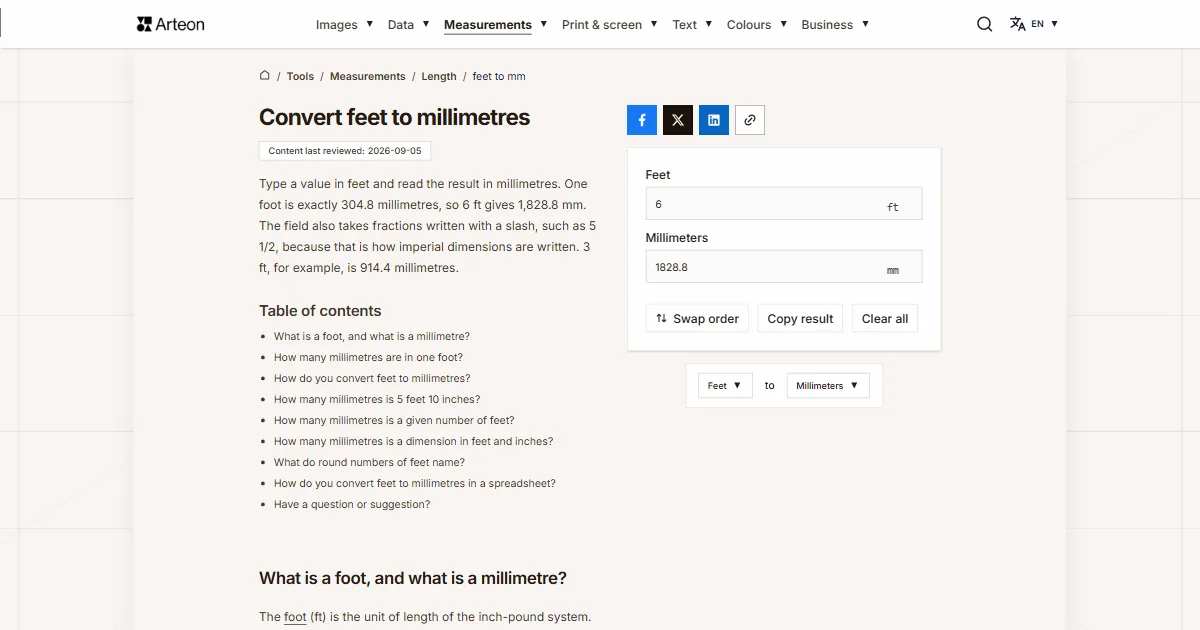
Type a value in feet and read the result in millimetres. One foot is exactly 304.8 millimetres, so 6 ft gives 1,828.8 mm. The field also takes fractions written with a slash, such as 5 1/2, because that is how imperial dimensions are written. 3 ft, for example, is 914.4 millimetres.
What is a foot, and what is a millimetre?
The foot (ft) is the unit of length of the inch-pound system. It divides into twelve inches, and three feet make a yard. The whole system rests on a single number: the 1959 agreement fixed the yard at exactly 0.9144 metres, and the foot is a third of that, which is exactly 0.3048 metres[1]. In millimetres that comes to 304.8.
The foot stays in daily use in the United States, in the United Kingdom and in aviation worldwide. British building has worked in millimetres since the 1970s, which is why a trade conversation held in feet ends with a delivery note written in millimetres.
A millimetre is one thousandth of a metre[2]. It is the unit of every metric engineering drawing and the one in which building components, openings and sections are specified. A dimension read in feet therefore has to be carried into millimetres before it reaches a drawing or an order.
How many millimetres are in one foot?
One foot is exactly 304.8 millimetres, or 30.48 centimetres. The definition states that figure outright, so it is exact to the last digit.
The numbers that follow from it come up again and again. Half a foot is 152.4 mm. Two feet give 609.6 mm. Six feet, the height quoted most often for a person, is 1,828.8 mm.
Whole numbers of feet land on millimetre values with one decimal place, because 304.8 has one. Multiples of five feet are the exception: 5 ft is exactly 1,524 mm, 10 ft is 3,048 mm and 20 ft is 6,096 mm.
The opposite direction, millimetres into feet, is handled by the millimetres to feet converter.
How do you convert feet to millimetres?
Multiply the feet by 304.8:
millimetres = feet × 304.8
Worked example: 8 × 304.8 = 2,438.4 mm.
Where a dimension is written as a fraction, type it into the field as it stands. The converter reads simple fractions such as 1/2 or 3/8 and mixed numbers such as 5 1/2, so a value off an imperial drawing needs no decimal conversion beforehand.
To do it by hand, turn the fraction into a decimal by dividing the top number by the bottom one. Three eighths of a foot is 3 ÷ 8, which is 0.375 feet. Multiplied by 304.8 that comes to 114.3 mm.
How many millimetres is 5 feet 10 inches?
Five feet ten inches is 1,778 millimetres. The same dimension written in decimal feet is 5.8333 feet.
The sum has two steps and each of them does something different to the number.
Step one: turn the inches into part of a foot by dividing them by twelve. Ten inches is 10 ÷ 12, which is 0.8333 feet. Add that to the whole feet and you have 5.8333 feet.
Step two: multiply the total by 304.8 and you get 1,778 mm.
A shorter route runs through inches alone. Five feet is 60 inches, so with ten more the total is 70 inches. Multiplied by 25.4 that gives the same 1,778 mm. That route is handled by the inches to millimetres converter, and the step from feet to inches by the feet to inches converter.
The same digits written with a decimal point describe a different length. The value 5.10 feet is five and one tenth of a foot, which is 1,554.5 mm. A decimal point splits the foot into ten parts, while the gap between the numbers in the compound notation splits it into twelve.
How many millimetres is a given number of feet?
| Feet | Millimetres | Centimetres |
|---|---|---|
| 0.1 ft | 30.48 mm | 3.048 cm |
| 0.25 ft | 76.2 mm | 7.62 cm |
| 0.5 ft | 152.4 mm | 15.24 cm |
| 0.75 ft | 228.6 mm | 22.86 cm |
| 1 ft | 304.8 mm | 30.48 cm |
| 1.5 ft | 457.2 mm | 45.72 cm |
| 2 ft | 609.6 mm | 60.96 cm |
| 2.5 ft | 762 mm | 76.2 cm |
| 3 ft | 914.4 mm | 91.44 cm |
| 3.5 ft | 1,066.8 mm | 106.68 cm |
| 4 ft | 1,219.2 mm | 121.92 cm |
| 4.5 ft | 1,371.6 mm | 137.16 cm |
| 5 ft | 1,524 mm | 152.4 cm |
| 5.5 ft | 1,676.4 mm | 167.64 cm |
| 6 ft | 1,828.8 mm | 182.88 cm |
| 6.5 ft | 1,981.2 mm | 198.12 cm |
| 7 ft | 2,133.6 mm | 213.36 cm |
| 7.5 ft | 2,286 mm | 228.6 cm |
| 8 ft | 2,438.4 mm | 243.84 cm |
| 8.5 ft | 2,590.8 mm | 259.08 cm |
| 9 ft | 2,743.2 mm | 274.32 cm |
| 9.5 ft | 2,895.6 mm | 289.56 cm |
| 10 ft | 3,048 mm | 304.8 cm |
| 11 ft | 3,352.8 mm | 335.28 cm |
| 12 ft | 3,657.6 mm | 365.76 cm |
| 13 ft | 3,962.4 mm | 396.24 cm |
| 14 ft | 4,267.2 mm | 426.72 cm |
| 15 ft | 4,572 mm | 457.2 cm |
| 16 ft | 4,876.8 mm | 487.68 cm |
| 17 ft | 5,181.6 mm | 518.16 cm |
| 18 ft | 5,486.4 mm | 548.64 cm |
| 20 ft | 6,096 mm | 609.6 cm |
| 21 ft | 6,400.8 mm | 640.08 cm |
| 22 ft | 6,705.6 mm | 670.56 cm |
| 24 ft | 7,315.2 mm | 731.52 cm |
| 25 ft | 7,620 mm | 762 cm |
| 26 ft | 7,924.8 mm | 792.48 cm |
| 28 ft | 8,534.4 mm | 853.44 cm |
| 30 ft | 9,144 mm | 914.4 cm |
| 32 ft | 9,753.6 mm | 975.36 cm |
| 35 ft | 10,668 mm | 1,066.8 cm |
| 40 ft | 12,192 mm | 1,219.2 cm |
| 45 ft | 13,716 mm | 1,371.6 cm |
| 50 ft | 15,240 mm | 1,524 cm |
| 60 ft | 18,288 mm | 1,828.8 cm |
| 70 ft | 21,336 mm | 2,133.6 cm |
| 80 ft | 24,384 mm | 2,438.4 cm |
| 90 ft | 27,432 mm | 2,743.2 cm |
| 100 ft | 30,480 mm | 3,048 cm |
How many millimetres is a dimension in feet and inches?
| Notation | Decimal feet | Millimetres |
|---|---|---|
| 1 ft 0 in | 1 ft | 304.8 mm |
| 1 ft 6 in | 1.5 ft | 457.2 mm |
| 2 ft 0 in | 2 ft | 609.6 mm |
| 2 ft 6 in | 2.5 ft | 762 mm |
| 3 ft 0 in | 3 ft | 914.4 mm |
| 3 ft 6 in | 3.5 ft | 1,066.8 mm |
| 4 ft 0 in | 4 ft | 1,219.2 mm |
| 4 ft 6 in | 4.5 ft | 1,371.6 mm |
| 5 ft 0 in | 5 ft | 1,524 mm |
| 5 ft 2 in | 5.1667 ft | 1,574.8 mm |
| 5 ft 4 in | 5.3333 ft | 1,625.6 mm |
| 5 ft 6 in | 5.5 ft | 1,676.4 mm |
| 5 ft 8 in | 5.6667 ft | 1,727.2 mm |
| 5 ft 10 in | 5.8333 ft | 1,778 mm |
| 5 ft 11 in | 5.9167 ft | 1,803.4 mm |
| 6 ft 0 in | 6 ft | 1,828.8 mm |
| 6 ft 1 in | 6.0833 ft | 1,854.2 mm |
| 6 ft 2 in | 6.1667 ft | 1,879.6 mm |
| 6 ft 4 in | 6.3333 ft | 1,930.4 mm |
| 6 ft 6 in | 6.5 ft | 1,981.2 mm |
| 7 ft 0 in | 7 ft | 2,133.6 mm |
| 8 ft 0 in | 8 ft | 2,438.4 mm |
| 10 ft 0 in | 10 ft | 3,048 mm |
| 12 ft 0 in | 12 ft | 3,657.6 mm |
What do round numbers of feet name?
| Feet | Millimetres | Centimetres | What it names |
|---|---|---|---|
| 4 ft | 1,219.2 mm | 121.92 cm | Width of a sheet of plywood, OSB or drywall |
| 6 ft | 1,828.8 mm | 182.88 cm | The height most often quoted for a person |
| 8 ft | 2,438.4 mm | 243.84 cm | Length of a standard sheet and height of a stud wall |
| 10 ft | 3,048 mm | 304.8 cm | Common length of dimensional lumber |
| 12 ft | 3,657.6 mm | 365.76 cm | Common length of dimensional lumber |
| 16 ft | 4,876.8 mm | 487.68 cm | Longest length of lumber most yards carry off the shelf |
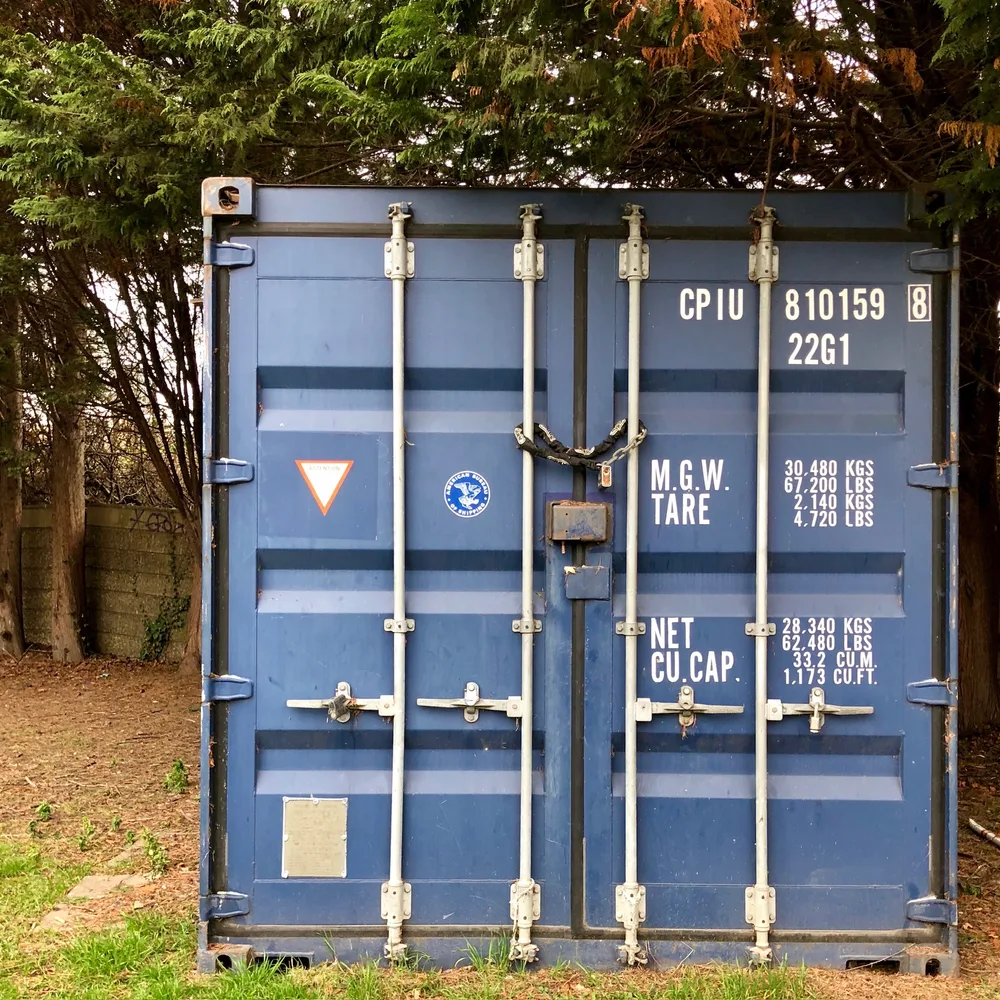
| 20 ft | 6,096 mm | 609.6 cm | The shorter class of shipping container |
| 40 ft | 12,192 mm | 1,219.2 cm | The longer class of shipping container |
How do you convert feet to millimetres in a spreadsheet?
For a single value the converter at the top of the page is quicker. For a whole column of dimensions out of a bill of materials it pays to write the formula once and drag it down.
Use the built-in conversion function
Excel has a function that knows both unit symbols. With the feet in column A, type =CONVERT(A1,"ft","mm") in the cell beside it and drag the formula down[4].Or multiply by the constant
The formula =A1*304.8 returns exactly the same answer, because 304.8 is an exact value. This version works in any spreadsheet and in any language version, since a multiplication depends neither on the name of the function nor on the list of units a given program supports.Split the compound notation first
Where a column holds dimensions written in feet and inches, separate it into two columns, feet and inches. The formula for millimetres is then =A1*304.8+B1*25.4 and it handles both parts at once. Splitting the columns is necessary here, because a spreadsheet reads 5.10 as five and one tenth of a foot, which is 1,554.5 mm, while five feet ten inches is 1,778 mm.Round to the tolerance you actually work to
Multiplying by 304.8 leaves one decimal place, so a column of feet turns into a column of tenths of a millimetre. Joinery and building work to whole millimetres, so wrapping the formula as =ROUND(A1*304.8,0) gives a figure that can go straight onto a cutting list.
Convert other units to Millimeters
Convert Feet to other units
Sources
- U.S. Survey Foot: Revised Unit Conversion Factors — National Institute of Standards and Technology
- SI base unit: metre (m) — Bureau International des Poids et Mesures
- Intermodal container — Wikipedia
- CONVERT function — Microsoft
Every figure in the tables was computed from the unit definitions and checked arithmetically before publication. Historical values and the names of local units come from the sources listed above.
Content last reviewed: · written and checked by the Arteon team
Najczęściej zadawane pytania
How many centimetres are in one foot?
A foot is 30.48 centimetres, or 304.8 millimetres. Three feet come to 91.44 centimetres. For an answer in metres, use the feet to metres converter.
How does a foot relate to an inch?
A foot divides into twelve inches and each inch is 25.4 mm. Twelve times 25.4 gives 304.8 mm, a full foot. That step is handled by the feet to inches converter.
How many millimetres is half a foot?
Half a foot is 152.4 mm. A quarter of a foot gives 76.2 mm and an eighth gives 38.1 mm. All three go into the converter as they stand, written 1/2, 1/4 and 1/8.
Where do the fractions 1/2, 1/4 and 1/8 on a tape measure come from?
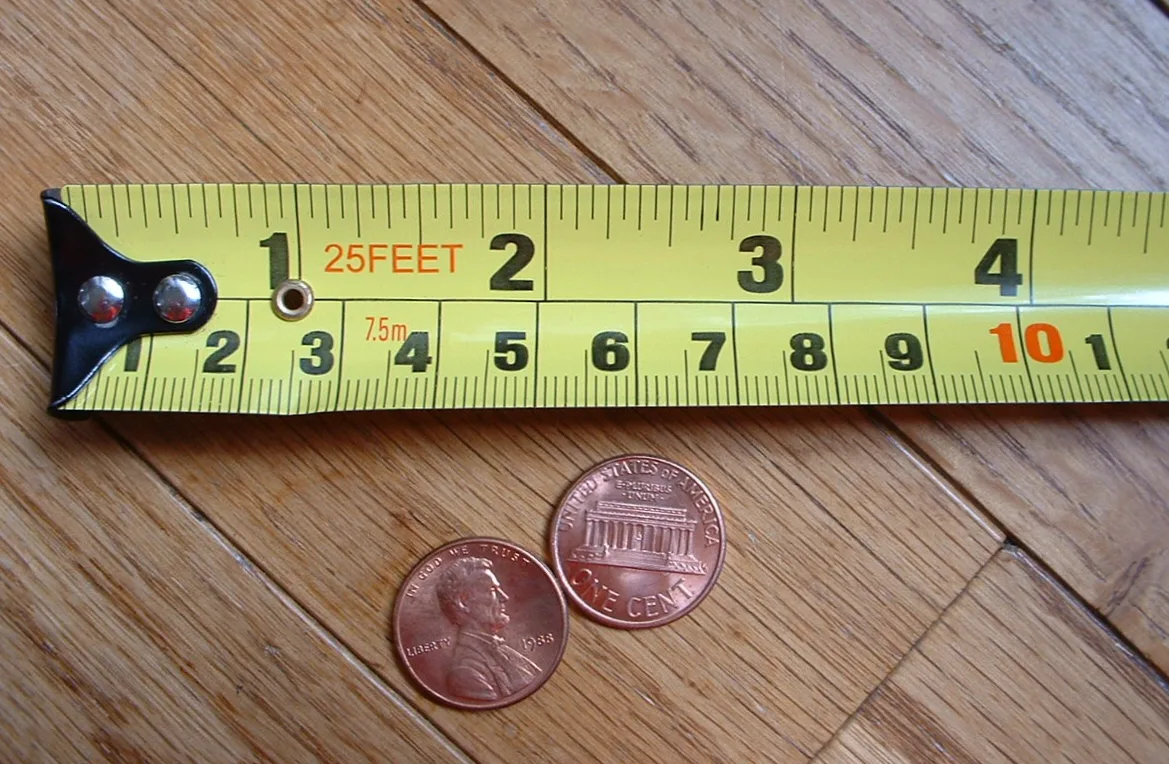
The inch is divided by halving: first into two parts, then four, eight, sixteen and so on. Those are the graduations marked on the blade, so dimensions are written in the same fractions. One sixteenth of an inch is 1.5875 mm and is the smallest division you can read straight off the tape.
Will the converter take a value written as a fraction?
Yes. The input field recognises simple fractions such as 1/2 and 3/8, and mixed numbers such as 5 1/2, where the space separates the whole feet from the fraction. It also accepts either a full stop or a comma as the decimal mark, so 5.5 and 5,5 give the same answer.
Have a question or suggestion?
If you spot an error in the tables or have an idea for improving the converter, get in touch. We reply to every message.