Convert meters to miles
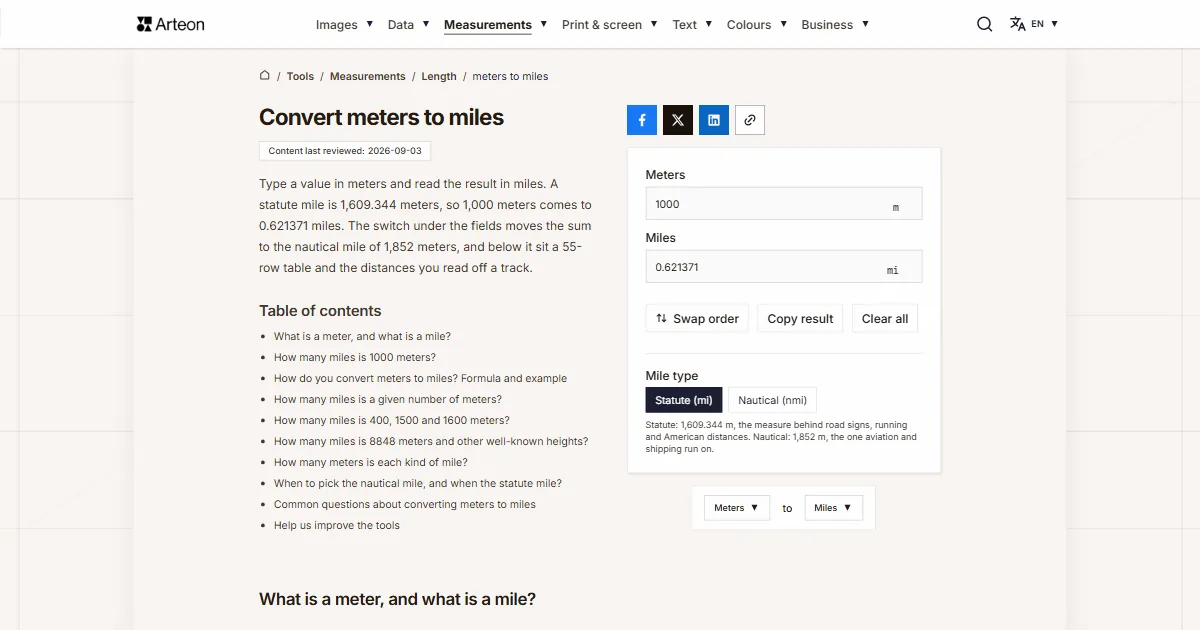
Type a value in meters and read the result in miles. A statute mile is 1,609.344 meters, so 1,000 meters comes to 0.621371 miles. The switch under the fields moves the sum to the nautical mile of 1,852 meters, and below it sit a 55-row table and the distances you read off a track.
What is a meter, and what is a mile?
The meter is a base unit of the SI (the International System of Units), and every metric length you meet is built on it. Its value rests on the speed of light: a meter is the distance light travels in a vacuum in 1/299,792,458 of a second[1]. That definition has a practical upshot — any standards laboratory can reproduce the meter on its own premises with an accurate clock and a light source.
The mile belongs to the imperial system, and it was assembled from units older than itself. The base was the furlong, the length of a furrow ploughed by a team of oxen. A mile holds eight furlongs, a furlong divides into ten chains, and a chain into four rods. The same division written in smaller units comes to 1,760 yards or 5,280 feet[2]. In metric units that works out at exactly 1,609.344 meters, a value that has held since 1959, when the English-speaking countries agreed on a single yard and pound[3].
Alongside it lives a second measure under the same name. The nautical mile is exactly 1,852 meters, and its length came out of measuring the Earth: it matches one minute of arc along a meridian[4]. Shipping and aviation run on it worldwide, which is why the distance to an airport on a flight map is quoted in it. The Mile type switch in the converter above moves the sum between the two.
In the United States and the United Kingdom the mile is the everyday measure, and the meter usually arrives from somewhere specific: the track, the swimming pool, the rowing ergometer, and the metric spec on a product. Those are the values that most often land in this converter.
How many miles is 1000 meters?
One thousand meters is 0.621371 statute miles. The same distance measured the way shipping measures it comes to 0.539957 nautical miles. Read the other way round, a statute mile is 1,609.344 meters and a nautical mile is 1,852 meters.
Beyond the round thousand, three values come up more often than any others, and all three come from the track. One lap, meaning 400 meters, is 0.248548 miles. The 1500 meters comes to 0.932057 miles. Four laps, meaning 1,600 meters, is 0.994194 miles.
That last figure explains the question people ask about the mile and four laps. A mile is 9.344 meters longer than four laps, so the mile race starts those nine meters ahead of the start of the 1,600 meters.
The converter above works in both directions and shows the result while you type, so any other value takes a couple of seconds.
How do you convert meters to miles? Formula and example
The conversion rests on a single constant: a statute mile is 1,609.344 meters. To turn meters into miles, you divide their number by that value.
The full formula: miles = meters ÷ 1,609.344. The other way round: meters = miles × 1,609.344.
The same sum can be written as a multiplication. One meter is 0.000621371 miles, so multiplying the number of meters by that value gives an identical result.
It shows up most clearly on a distance every runner knows. Five thousand meters divided by 1,609.344 comes to 3.106856 miles. Running apps show that same distance as 3.1 miles, because they cut the result to one decimal place.
For the nautical mile one number in the formula changes: you divide by 1,852. One thousand meters then comes to 0.539957 nautical miles. The gap between the two miles runs to fifteen percent and grows with the distance — a hundred nautical miles is 185,200 meters, while a hundred statute miles is 160,934.4 meters.
If your value is already written in miles, the way back is handled by the miles to meters converter.
How many miles is a given number of meters?
| Meters | Statute miles (mi) | Nautical miles (nmi) |
|---|---|---|
| 1 m | 0.000621 mi | 0.00054 nmi |
| 5 m | 0.003107 mi | 0.0027 nmi |
| 10 m | 0.006214 mi | 0.0054 nmi |
| 20 m | 0.012427 mi | 0.010799 nmi |
| 25 m | 0.015534 mi | 0.013499 nmi |
| 30 m | 0.018641 mi | 0.016199 nmi |
| 40 m | 0.024855 mi | 0.021598 nmi |
| 50 m | 0.031069 mi | 0.026998 nmi |
| 60 m | 0.037282 mi | 0.032397 nmi |
| 70 m | 0.043496 mi | 0.037797 nmi |
| 75 m | 0.046603 mi | 0.040497 nmi |
| 80 m | 0.04971 mi | 0.043197 nmi |
| 90 m | 0.055923 mi | 0.048596 nmi |
| 100 m | 0.062137 mi | 0.053996 nmi |
| 120 m | 0.074565 mi | 0.064795 nmi |
| 130 m | 0.080778 mi | 0.070194 nmi |
| 140 m | 0.086992 mi | 0.075594 nmi |
| 150 m | 0.093206 mi | 0.080994 nmi |
| 160 m | 0.099419 mi | 0.086393 nmi |
| 180 m | 0.111847 mi | 0.097192 nmi |
| 200 m | 0.124274 mi | 0.107991 nmi |
| 220 m | 0.136702 mi | 0.11879 nmi |
| 240 m | 0.149129 mi | 0.12959 nmi |
| 250 m | 0.155343 mi | 0.134989 nmi |
| 270 m | 0.16777 mi | 0.145788 nmi |
| 300 m | 0.186411 mi | 0.161987 nmi |
| 350 m | 0.21748 mi | 0.188985 nmi |
| 400 m | 0.248548 mi | 0.215983 nmi |
| 450 m | 0.279617 mi | 0.242981 nmi |
| 500 m | 0.310686 mi | 0.269978 nmi |
| 550 m | 0.341754 mi | 0.296976 nmi |
| 600 m | 0.372823 mi | 0.323974 nmi |
| 650 m | 0.403891 mi | 0.350972 nmi |
| 800 m | 0.497097 mi | 0.431965 nmi |
| 850 m | 0.528166 mi | 0.458963 nmi |
| 900 m | 0.559234 mi | 0.485961 nmi |
| 1,000 m | 0.621371 mi | 0.539957 nmi |
| 1,200 m | 0.745645 mi | 0.647948 nmi |
| 1,500 m | 0.932057 mi | 0.809935 nmi |
| 1,600 m | 0.994194 mi | 0.863931 nmi |
| 1,609.344 m | 1 mi | 0.868976 nmi |
| 2,000 m | 1.242742 mi | 1.079914 nmi |
| 2,500 m | 1.553428 mi | 1.349892 nmi |
| 3,000 m | 1.864114 mi | 1.61987 nmi |
| 3,500 m | 2.174799 mi | 1.889849 nmi |
| 4,000 m | 2.485485 mi | 2.159827 nmi |
| 5,000 m | 3.106856 mi | 2.699784 nmi |
| 8,848.86 m | 5.498427 mi | 4.778002 nmi |
| 10,000 m | 6.213712 mi | 5.399568 nmi |
| 15,000 m | 9.320568 mi | 8.099352 nmi |
| 20,000 m | 12.427424 mi | 10.799136 nmi |
| 21,097.5 m | 13.109379 mi | 11.391739 nmi |
| 42,195 m | 26.218757 mi | 22.783477 nmi |
| 50,000 m | 31.06856 mi | 26.99784 nmi |
| 100,000 m | 62.137119 mi | 53.99568 nmi |
The 1,609.344 m row is the exact length of a statute mile, and 8,848.86 m is the height of Mount Everest set by the joint Nepalese and Chinese survey of 2020. The 21,097.5 m and 42,195 m rows are the half marathon and the marathon. The same distances written in kilometers are handled by the meters to kilometers converter.
How many miles is 400, 1500 and 1600 meters?
| Distance | Meters | Miles | Laps of the track |
|---|---|---|---|
| 100-metre sprint | 100 m | 0.0621 mi | 0.25 |
| 200-metre sprint | 200 m | 0.1243 mi | 0.5 |
| One lap of the track | 400 m | 0.2485 mi | 1 |
| 800 metres | 800 m | 0.4971 mi | 2 |
| 1000 metres | 1,000 m | 0.6214 mi | 2.5 |
| The metric mile | 1,500 m | 0.9321 mi | 3.75 |
| Four laps of the track | 1,600 m | 0.9942 mi | 4 |
| The mile race | 1,609.344 m | 1 mi | 4.0234 |
| Standard rowing-ergometer piece | 2,000 m | 1.2427 mi | 5 |
| 3000 metres | 3,000 m | 1.8641 mi | 7.5 |
| 5000 metres | 5,000 m | 3.1069 mi | 12.5 |
| 10,000 metres | 10,000 m | 6.2137 mi | 25 |
The name metric mile belongs in athletics to the 1500 meters, and United States high-school competition gives the same name to the 1,600 meters[5]. Swimmers use it too: the 1500 meters in a fifty-meter pool is known as the swimmer's mile, and the short-course version is 1,650 yards, which is 1,508.76 meters — exactly fifteen sixteenths of a mile. Distances written in kilometers are covered by the kilometers to miles converter.
How many miles is 8848 meters and other well-known heights?
| Place | Meters | Statute miles |
|---|---|---|
| The Shard, London | 309.6 m | 0.1924 mi |
| Burj Khalifa, Dubai | 828 m | 0.5145 mi |
| Ben Nevis | 1,345 m | 0.8357 mi |
| Denver, the Mile High City | 1,609.34 m | 1 mi |
| Mount Everest | 8,848.86 m | 5.4984 mi |
| Cruising altitude FL350 | 10,668 m | 6.6288 mi |
Denver is the one entry that comes out at a round mile: the city's official elevation is exactly one mile above sea level, marked by a benchmark on the steps of the Colorado State Capitol, and in meters that is the 1,609.344 in the table[6]. Cruising altitude FL350 means 35,000 feet, which is exactly 10,668 meters — heights quoted in feet are handled by the meters to feet converter.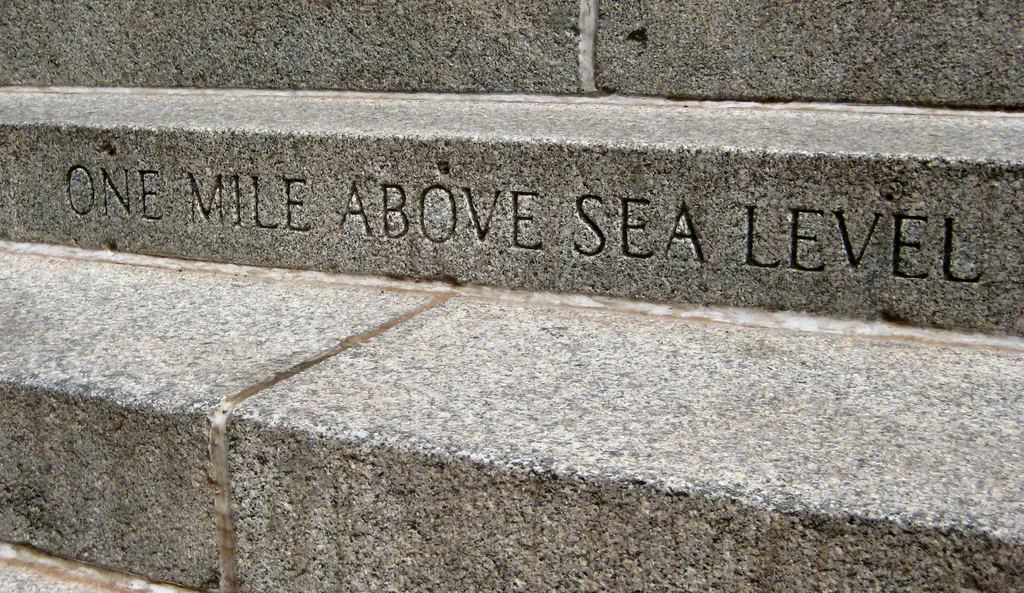
How many meters is each kind of mile?
| Kind of mile | Meters | Against the statute mile | Where you meet it |
|---|---|---|---|
| Statute mile | 1,609.344 m | 1 | Roads, running and every American distance, in the United States and the United Kingdom. Selected by default in the converter. |
| Nautical mile | 1,852 m | 1.151 | Shipping and aviation worldwide. The second option in the converter. |
| Scandinavian mile (mil) | 10,000 m | 6.214 | Sweden and Norway, in everyday use to this day. |
| US survey mile | 1,609.3472 m | 1 | American land surveying up to 31 December 2022. |
| Roman mile (mille passus) | 1,479 m | 0.919 | Ancient Rome. A thousand paces of a marching legionary, which is where the name comes from. |
| Land league | 4,828 m | 3 | An old English measure equal to three statute miles. |
| Irish mile | 2,048.256 m | 1.273 | Ireland up to metrication. It held 2,240 yards, so it ran a quarter longer than the statute mile. |
The Scandinavian mile is a round 10,000 meters and is still in everyday use in Sweden and Norway, so a car advertised there with 12 miles on the clock has covered 120,000 meters. The US survey mile applied to American land surveying up to 31 December 2022; since 1 January 2023 all surveying rests on the international foot[3]. The same units expressed in feet are set out by the feet to miles converter.
When to pick the nautical mile, and when the statute mile?
The Mile type switch sits under both columns of the converter. The situations below cover practically everything you meet when the value in front of you is in meters.
Track, pool and running app: statute mile
Sports distances are set in meters, and apps switched to US units report them in statute miles. Five thousand meters comes to 3.106856 miles. Ten thousand meters is 6.213712 miles. Both figures appear with the switch left as it is, on the Statute (mi) option.Summit, building and flight level: statute mile
Anything measured vertically converts to statute miles. Mount Everest stands at 8,848.86 meters, which is 5.498427 miles above sea level. The Burj Khalifa reaches 828 meters, giving 0.514495 miles.Chart, flight plan and the letters NM: nautical mile
Shipping and aviation measure in nautical miles, because one such mile matches a minute of arc along a meridian. The abbreviations that signal it in a source are NM, nmi and M. Click the Nautical (nmi) option then, and ten thousand meters gives 5.399568 nautical miles. Speed in this field is quoted in knots, and one knot is one nautical mile per hour.A whole column of values: spreadsheet
For a single number the field above is quicker, and for a whole column of distances a spreadsheet does it with one formula dragged down. In Excel the formula reads =CONVERT(A1,"m","mi"), and for the nautical mile you swap the last code for "Nmi"[7]. The formula =A1/1609.344 gives the same result and works in Google Sheets and LibreOffice Calc as well.
Sources
- SI base unit: metre (m) — Bureau International des Poids et Mesures
- Mile — Wikipedia
- U.S. Survey Foot: Revised Unit Conversion Factors — National Institute of Standards and Technology
- Nautical mile — Wikipedia
- Metric mile — Wikipedia
- Denver — Wikipedia
- CONVERT function — Microsoft
Every figure in the tables was computed from the unit definitions and checked arithmetically before publication. Historical values and the names of local units come from the sources listed above.
Content last reviewed: · written and checked by the Arteon team
Common questions about converting meters to miles
How many miles is 1000 meters?
One thousand meters is 0.621371 statute miles and 0.539957 nautical miles. Five hundred meters gives 0.310686 miles and 0.269978 nautical miles respectively.
Is 1600 meters a mile?
A statute mile is 1,609.344 meters, which is 9.344 meters more than 1,600 meters. Four laps of a standard track come to exactly 1,600 meters, and the mile race adds those nine meters on top.
How many laps of a track is one mile?
A mile is 4.0234 laps, meaning four full laps and another 9.344 meters. A single lap in lane one measures 400 meters, which comes to 0.248548 miles.
How many miles is 400 meters?
Four hundred meters is 0.248548 miles, just under a quarter mile. A quarter mile measured exactly is 402.336 meters, so 2.336 meters separate the two.
How many meters is a nautical mile?
A nautical mile is exactly 1,852 meters. The value was set in 1929 and comes from one minute of arc along a meridian. In the converter you pick it with the Nautical (nmi) button.
How many miles is 1500 meters in the pool?
Fifteen hundred meters is 0.932057 miles. Swimmers call that distance the mile, and in a short-course yard pool the same role is played by 1,650 yards, which is 1,508.76 meters. That second distance is exactly fifteen sixteenths of a mile.
Does the field accept decimals?
Yes. You can enter 1603.3 or 1603,3, and a simple fraction such as 1/2 as well. The result appears while you type, with no separate button to press. The other direction is handled by the miles to meters converter.
Help us improve the tools
Got an idea for a new feature, found a bug, or want to suggest another tool? Write to us — we reply within 24 hours.