Convert kilometers to meters
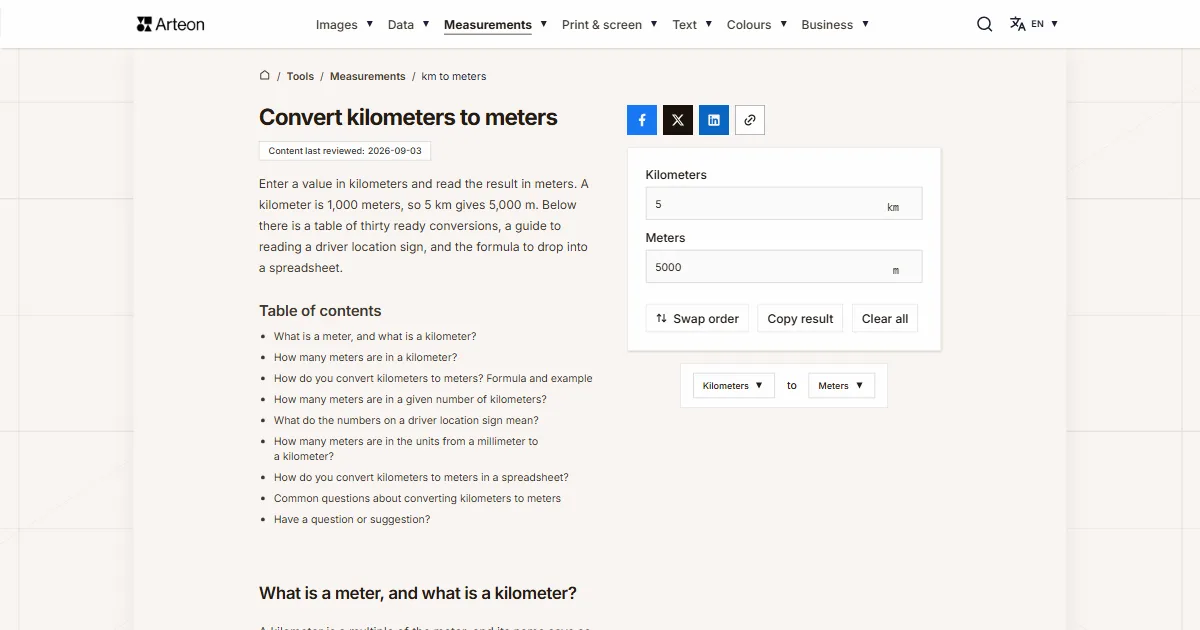
Enter a value in kilometers and read the result in meters. A kilometer is 1,000 meters, so 5 km gives 5,000 m. Below there is a table of thirty ready conversions, a guide to reading a driver location sign, and the formula to drop into a spreadsheet.
What is a meter, and what is a kilometer?
A kilometer is a multiple of the meter, and its name says as much. The prefix kilo- means a factor of one thousand in the SI system, so a kilometer is one thousand meters — in the same way a kilogram is one thousand grams and a kilobyte one thousand bytes. The kilometer has no definition of its own, because it takes its whole value from the meter.
The meter is one of the seven SI base units, and it sets the length of everything this page converts. Since 1983 its value has rested on the speed of light: a meter is the distance light travels in a vacuum in 1/299,792,458 of a second[1]. Earlier the job belonged to a platinum-iridium bar kept at Sèvres near Paris, which defined the meter for seventy-one years, from 1889 to 1960[2].
Which of the two you reach for comes down to convenient numbers. Meters describe a running track, a swimming pool and the height of a building. Kilometers take over once the figure in meters grows unwieldy: a drive, a race distance, the gap between two cities.
How many meters are in a kilometer?
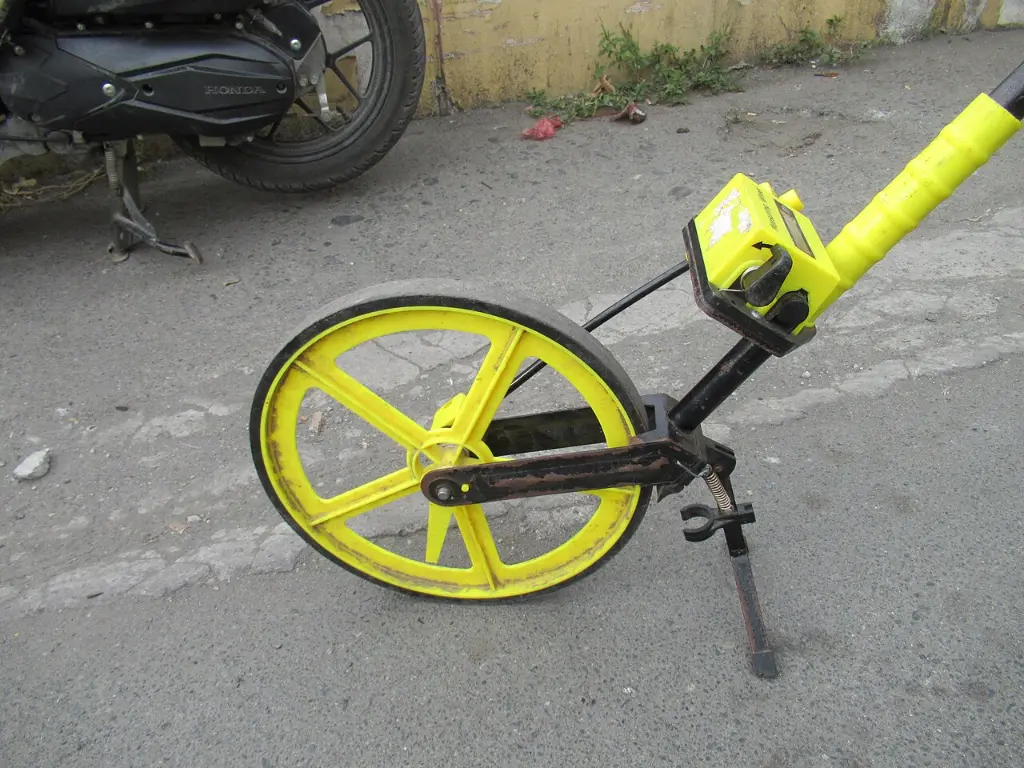
A kilometer is 1,000 meters. Five kilometers works out to 5,000 meters. Half a kilometer is 500 meters. Every conversion in this direction comes down to multiplying the number of kilometers by a thousand.
Beyond the round kilometer, three values come up in search more often than the rest. A quarter of a kilometer is 250 meters. Two kilometers gives 2,000 meters. Twenty kilometers works out to 20,000 meters.
The converter above runs both ways and shows the result as you type, so none of these numbers is worth memorizing.
How do you convert kilometers to meters? Formula and example
The conversion rests on a fixed relationship: one kilometer is 1,000 meters. To turn kilometers into meters, you multiply their number by a thousand.
The full formula: meters = kilometers × 1000. The other way round: kilometers = meters ÷ 1000.
Three numbers follow from that formula more often than any others. Five kilometers multiplied by a thousand gives 5,000 meters, the distance runners know as a 5K. Ten kilometers gives 10,000 meters the same way. A marathon measures 42.195 kilometers, so multiplying leaves 42,195 meters.
That last example shows what multiplying by a thousand looks like written out: the digits stay as they are and the decimal point moves three places to the right. From 1.2 kilometers you get 1,200 meters, and from 0.75 kilometers you get 750 meters. Any gaps the shift leaves behind are filled with zeros.
Going the other way reverses the step: you divide by a thousand and the decimal point travels three places to the left. That is what the meters to kilometers converter does when your value is written in meters.
How many meters are in a given number of kilometers?
| Kilometers | Meters |
|---|---|
| 0.1 km | 100 m |
| 0.25 km | 250 m |
| 0.5 km | 500 m |
| 0.75 km | 750 m |
| 1 km | 1,000 m |
| 1.2 km | 1,200 m |
| 1.5 km | 1,500 m |
| 2 km | 2,000 m |
| 2.5 km | 2,500 m |
| 3 km | 3,000 m |
| 3.5 km | 3,500 m |
| 4 km | 4,000 m |
| 5 km | 5,000 m |
| 6 km | 6,000 m |
| 7 km | 7,000 m |
| 8 km | 8,000 m |
| 9 km | 9,000 m |
| 10 km | 10,000 m |
| 15 km | 15,000 m |
| 20 km | 20,000 m |
| 21.0975 km | 21,097.5 m |
| 25 km | 25,000 m |
| 30 km | 30,000 m |
| 42.195 km | 42,195 m |
| 50 km | 50,000 m |
| 100 km | 100,000 m |
| 104 km | 104,000 m |
| 500 km | 500,000 m |
| 1,000 km | 1,000,000 m |
| 1,200 km | 1,200,000 m |
The 21.0975 km and 42.195 km rows are the half marathon and the marathon. For the same distances written in miles, use the kilometers to miles converter.
What do the numbers on a driver location sign mean?
| Figure on the sign | Kilometers | Meters past that kilometer | Meters from the start |
|---|---|---|---|
| 0.5 | 0 km | 500 m | 500 m |
| 3.0 | 3 km | 0 m | 3,000 m |
| 12.5 | 12 km | 500 m | 12,500 m |
| 45.5 | 45 km | 500 m | 45,500 m |
| 100.0 | 100 km | 0 m | 100,000 m |
| 198.5 | 198 km | 500 m | 198,500 m |
| 250.5 | 250 km | 500 m | 250,500 m |
The lines above the figure name the road and the carriageway, which is what an emergency operator needs alongside the distance[3]. Because the posts go up in half kilometers, the decimal on a sign is normally .0 or .5. The figure is metric on a road network that posts every other distance in miles.
How many meters are in the units from a millimeter to a kilometer?
| Unit | Symbol | Meters | Kilometers |
|---|---|---|---|
| Millimeter | mm | 0.001 m | 0.000001 km |
| Centimeter | cm | 0.01 m | 0.00001 km |
| Decimeter | dm | 0.1 m | 0.0001 km |
| Meter | m | 1 m | 0.001 km |
| Dekameter | dam | 10 m | 0.01 km |
| Hectometer | hm | 100 m | 0.1 km |
| Kilometer | km | 1,000 m | 1 km |
The two smallest units in this table are converted into each other by the centimeters to millimeters converter.
How do you convert kilometers to meters in a spreadsheet?
For a single value the field above is quicker, but for a whole column of distances a spreadsheet handles it with one formula dragged down.
Excel: the CONVERT function
You write CONVERT(number, from_unit, to_unit). The unit code for a kilometer is "km" and for a meter "m", so for a value in cell A1 the formula reads =CONVERT(A1,"km","m"). The function works in Excel 2024 and in Excel from a Microsoft 365 subscription[4].Plain multiplication, if you would rather skip the function
=A1*1000 returns the same result and works in every spreadsheet, Google Sheets and LibreOffice Calc included. With large numbers it helps to switch on the thousands separator so that 1000000 shows as 1,000,000.Check the formula on one cell first
Before you drag it down a whole column, type 42.195 into cell A1 and check that the result reads 42,195. A #VALUE! error in place of the number means A1 is formatted as text. You change that on the Home tab, in the Number group.
Sources
- SI base unit: metre (m) — Bureau International des Poids et Mesures
- Metre — Wikipedia
- Driver location sign — Wikipedia
- CONVERT function — Microsoft
Every figure in the tables was computed from the unit definitions and checked arithmetically before publication. Historical values and the names of local units come from the sources listed above.
Content last reviewed: · written and checked by the Arteon team
Common questions about converting kilometers to meters
How many meters are in 1 kilometer?
A kilometer is 1,000 meters. The prefix kilo- means a factor of one thousand in the SI system, so the number follows straight from the name of the unit.
How many meters are in half a kilometer?
Half a kilometer is 500 meters. A quarter of a kilometer gives 250 meters, and three quarters of a kilometer 750 meters.
How many meters are in 5 km?
Five kilometers is 5,000 meters. Ten kilometers gives 10,000 meters, and twenty kilometers 20,000 meters.
How do you write 1,500 meters in kilometers?
One thousand five hundred meters is 1.5 kilometers. You divide the number of meters by a thousand, which moves the decimal point three places to the left. The meters to kilometers converter has a full table of such values.
How many kilometers are in a mile?
A statute mile is 1.609344 kilometers, which is 1,609.344 meters. Two kilometers are therefore longer than one mile. The kilometers to miles converter handles both directions. If your value is written in meters, the meters to miles converter works it out.
What do the numbers on a driver location sign mean?
The bottom line gives the distance from the start of the road in kilometers, to one decimal place. The signs stand every 500 meters, so a reading of 45.5 marks a spot 45,500 meters from that starting point.
Does the field accept decimals?
Yes. You can type 1.5, and a simple fraction such as 1/2 works as well. The result appears as you type, with no separate button to press.
Have a question or suggestion?
If you spotted an error in the tables or have an idea to improve the converter, write to us — we reply within 24 hours.