Convert meters to yards
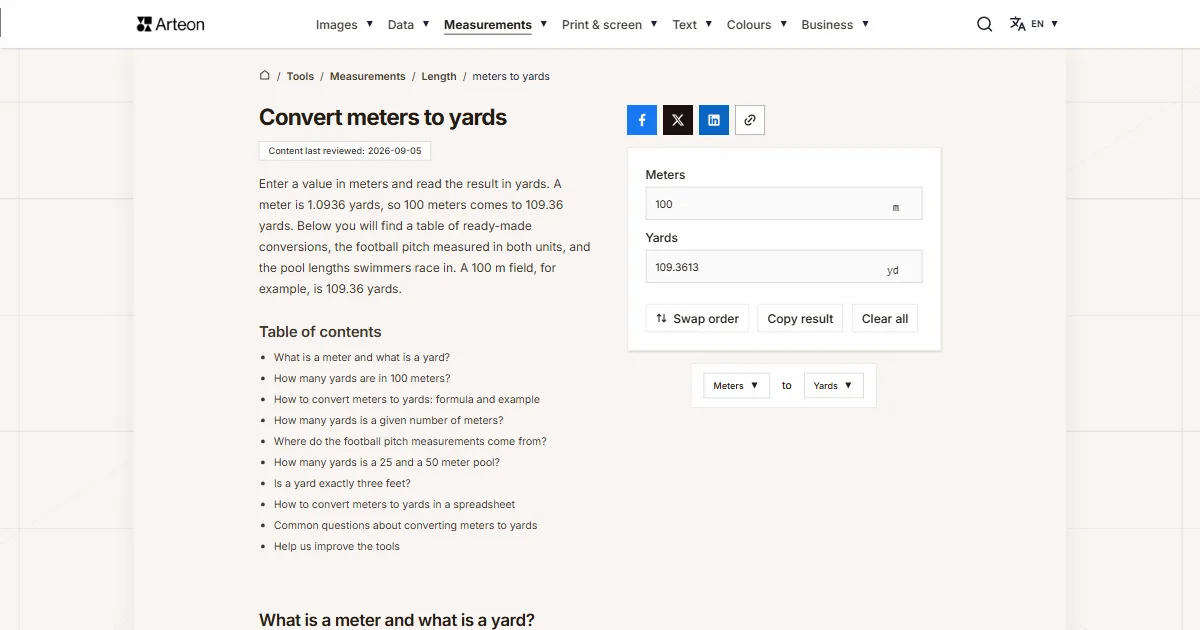
Enter a value in meters and read the result in yards. A meter is 1.0936 yards, so 100 meters comes to 109.36 yards. Below you will find a table of ready-made conversions, the football pitch measured in both units, and the pool lengths swimmers race in. A 100 m field, for example, is 109.36 yards.
What is a meter and what is a yard?
The meter is one of the seven base units of the SI system, and every other length is now expressed in relation to it. Since 1983 its length has rested on the speed of light: a meter is the distance light travels in a vacuum in 1/299,792,458 of a second[1].
The yard belongs to the imperial system and divides into three feet or thirty-six inches. It takes its length straight from the meter. On 1 July 1959 Australia, Canada, New Zealand, South Africa, the United Kingdom and the United States adopted an agreement that fixed the yard at 0.9144 meters[2]. A conference held the year before had settled the principle, namely that the English-speaking nations would base their standards of length and mass on metric measures[3].
One consequence makes every conversion on this page exact. A yard has no physical standard of its own any more, so a measurement written in yards is a metric measurement underneath, and the arithmetic carries no rounding of its own.
The unit stayed in everyday use across the English-speaking world. British road signs are the clearest case, because there the yard is required by law: a distance under half a mile is shown either in quarter miles or in yards rounded to the nearest ten[4]. That is where the 300 yds sign before a slip road comes from.
How many yards are in 100 meters?
One hundred meters is 109.36 yards. On round figures the pattern shows clearly: fifty meters gives 54.68 yards, and a thousand meters comes to 1,093.61 yards.
A meter is longer than a yard by 8.56 centimeters. Over a single stride that gap is hard to notice, but it grows with the distance. Across a hundred meters it adds up to 8.56 meters, which is exactly how far a sprinter still has to run at the moment a rival finishing a hundred-yard dash crosses the line.
That answers the question people ask most often about these two units. For the same figure, the distance written in meters is always the longer one. Five meters is 5.47 yards. Fifty meters is 54.68 yards. A hundred meters is 109.36 yards, so a hundred-yard course ends 8.56 meters sooner.
How to convert meters to yards: formula and example
The formula has a single step: divide the number of meters by 0.9144.
Multiplying by 1.0936133 gives the same answer, since one figure is the reciprocal of the other. Dividing by 0.9144 is the exact route, because that is the definition of the yard; the multiplier is already a rounded value and drifts from the division over very long distances.
Take one number as an example. A short course pool is 25 meters long. Divide 25 by 0.9144 and the answer is 27.34, so that pool measures 27.34 yards.
The reverse direction is handled by the yards to meters converter. For another imperial unit, take the meters to feet converter, since a yard is exactly three feet. Within the metric system there are the meters to kilometers and meters to centimeters converters.
How many yards is a given number of meters?
| Meters | Yards | Feet |
|---|---|---|
| 0.1 m | 0.11 yd | 0.33 ft |
| 0.5 m | 0.55 yd | 1.64 ft |
| 1 m | 1.09 yd | 3.28 ft |
| 2 m | 2.19 yd | 6.56 ft |
| 3 m | 3.28 yd | 9.84 ft |
| 4 m | 4.37 yd | 13.12 ft |
| 5 m | 5.47 yd | 16.40 ft |
| 6 m | 6.56 yd | 19.69 ft |
| 7 m | 7.66 yd | 22.97 ft |
| 8 m | 8.75 yd | 26.25 ft |
| 9 m | 9.84 yd | 29.53 ft |
| 10 m | 10.94 yd | 32.81 ft |
| 12 m | 13.12 yd | 39.37 ft |
| 15 m | 16.40 yd | 49.21 ft |
| 18 m | 19.69 yd | 59.06 ft |
| 20 m | 21.87 yd | 65.62 ft |
| 22 m | 24.06 yd | 72.18 ft |
| 25 m | 27.34 yd | 82.02 ft |
| 30 m | 32.81 yd | 98.43 ft |
| 35 m | 38.28 yd | 114.83 ft |
| 40 m | 43.74 yd | 131.23 ft |
| 45 m | 49.21 yd | 147.64 ft |
| 50 m | 54.68 yd | 164.04 ft |
| 55 m | 60.15 yd | 180.45 ft |
| 60 m | 65.62 yd | 196.85 ft |
| 65 m | 71.08 yd | 213.25 ft |
| 70 m | 76.55 yd | 229.66 ft |
| 75 m | 82.02 yd | 246.06 ft |
| 80 m | 87.49 yd | 262.47 ft |
| 85 m | 92.96 yd | 278.87 ft |
| 90 m | 98.43 yd | 295.28 ft |
| 91.44 m | 100.00 yd | 300.00 ft |
| 95 m | 103.89 yd | 311.68 ft |
| 100 m | 109.36 yd | 328.08 ft |
| 105 m | 114.83 yd | 344.49 ft |
| 110 m | 120.30 yd | 360.89 ft |
| 120 m | 131.23 yd | 393.70 ft |
| 125 m | 136.70 yd | 410.10 ft |
| 137.16 m | 150.00 yd | 450.00 ft |
| 150 m | 164.04 yd | 492.13 ft |
| 160 m | 174.98 yd | 524.93 ft |
| 175 m | 191.38 yd | 574.15 ft |
| 180 m | 196.85 yd | 590.55 ft |
| 200 m | 218.72 yd | 656.17 ft |
| 250 m | 273.40 yd | 820.21 ft |
| 300 m | 328.08 yd | 984.25 ft |
| 350 m | 382.76 yd | 1,148.29 ft |
| 400 m | 437.45 yd | 1,312.34 ft |
| 450 m | 492.13 yd | 1,476.38 ft |
| 500 m | 546.81 yd | 1,640.42 ft |
| 600 m | 656.17 yd | 1,968.50 ft |
| 700 m | 765.53 yd | 2,296.59 ft |
| 750 m | 820.21 yd | 2,460.63 ft |
| 800 m | 874.89 yd | 2,624.67 ft |
| 900 m | 984.25 yd | 2,952.76 ft |
| 1,000 m | 1,093.61 yd | 3,280.84 ft |
| 1,200 m | 1,312.34 yd | 3,937.01 ft |
| 1,500 m | 1,640.42 yd | 4,921.26 ft |
| 1,609.344 m | 1,760.00 yd | 5,280.00 ft |
| 2,000 m | 2,187.23 yd | 6,561.68 ft |
| 3,000 m | 3,280.84 yd | 9,842.52 ft |
| 5,000 m | 5,468.07 yd | 16,404.20 ft |
| 10,000 m | 10,936.13 yd | 32,808.40 ft |
Where do the football pitch measurements come from?
| Part of the pitch | Laws of the Game | In yards | Exact conversion |
|---|---|---|---|
| Penalty area depth | 16.5 m | 18 yards | 16.4592 m |
| Penalty mark distance | 11 m | 12 yards | 10.9728 m |
| Goal area depth | 5.5 m | 6 yards | 5.4864 m |
| Centre circle radius | 9.15 m | 10 yards | 9.144 m |
| Goal width | 7.32 m | 8 yards | 7.3152 m |
| Corner arc radius | 1 m | 1 yard | 0.9144 m |
| Goal height | 2.44 m | 8 feet | 2.4384 m |
How many yards is a 25 and a 50 meter pool?
| Distance | Meters | Yards | Yard equivalent |
|---|---|---|---|
| Short course pool length | 25 m | 27.34 yd | 25 yd (22.86 m) |
| Olympic pool length | 50 m | 54.68 yd | No yard pool is built at this length |
| Sprint over one length | 50 m | 54.68 yd | 50 yd (45.72 m) |
| Hundred-unit event | 100 m | 109.36 yd | 100 yd (91.44 m) |
| Two-hundred-unit event | 200 m | 218.72 yd | 200 yd (182.88 m) |
| Middle-distance freestyle | 400 m | 437.45 yd | 500 yd (457.20 m) |
| Distance freestyle | 800 m | 874.89 yd | 1,000 yd (914.40 m) |
| Longest individual event | 1,500 m | 1,640.42 yd | 1,650 yd (1,508.76 m) |
Is a yard exactly three feet?
| Unit | In yards | Meters | Where you meet it |
|---|---|---|---|
| Inch (in) | 1/36 | 0.0254 m | Screen diagonals, pipe diameters and wheel sizes. |
| Foot (ft) | 1/3 | 0.3048 m | Flight levels in aviation and a person’s height. |
| Yard (yd) | 1 | 0.9144 m | Playing fields, golf courses and British road signs. |
| Chain | 22 | 20.1168 m | A cricket pitch measures exactly one chain. |
| Furlong | 220 | 201.168 m | Horse racing distances in Britain, Ireland and the United States. |
| Mile (mi) | 1760 | 1,609.344 m | Road distances and running in the United States and Britain. |
How to convert meters to yards in a spreadsheet
For a single value the field above is quicker, but for a whole column of distances a spreadsheet does the work with one formula dragged downwards.
Excel: the CONVERT function
The syntax is CONVERT(number, from_unit, to_unit). The meter carries the code "m" and the yard the code "yd", so for a value in cell A1 the formula reads =CONVERT(A1,"m","yd")[7].Plain division, without a function
The formula =A1/0.9144 returns the same answer and works in every spreadsheet, including Google Sheets and LibreOffice Calc. If you prefer multiplying, use =A1*1.0936133 and keep in mind that this multiplier is rounded.Checking the result on one cell
Before dragging the formula down the column, put 100 into cell A1 and confirm the answer starts with 109.36. A #VALUE! message in place of the result means cell A1 is formatted as text; the format is on the Home tab, in the Number group.
Convert other units to Yards
Convert Meters to other units
Sources
- SI base unit: metre (m) — Bureau International des Poids et Mesures
- International yard and pound — Wikipedia
- SI Units – Length — National Institute of Standards and Technology
- The Traffic Signs Regulations and General Directions 2016, Schedule 18 — legislation.gov.uk
- Laws of the Game, Law 1: The Field of Play — The International Football Association Board
- Masters Swimming 101: Yards and Meters — U.S. Masters Swimming
- CONVERT function — Microsoft
Every figure in the tables was computed from the unit definitions and checked arithmetically before publication. Historical values and the names of local units come from the sources listed above.
Content last reviewed: · written and checked by the Arteon team
Common questions about converting meters to yards
Is a meter longer than a yard?
Yes, by 8.56 centimeters. A yard is 0.9144 meters, so it falls short of a full meter by exactly that much.
How many yards are in 100 meters?
One hundred meters is 109.36 yards. Fifty meters gives 54.68 yards, and a thousand meters comes to 1,093.61 yards.
Why is a yard exactly 0.9144 meters?
That value was set by the agreement adopted on 1 July 1959 by Australia, Canada, New Zealand, South Africa, the United Kingdom and the United States. Each of those countries had kept its own physical standard before, and the values differed by fractions of a micrometer.
Is a yard always three feet?
Yes. A yard divides into three feet or thirty-six inches, and the division is exact. A foot is 0.3048 meters, so three feet make 0.9144 meters, which is one yard.
Is a 100-yard swim the same as a 100-meter swim?
A hundred yards is 91.44 meters, which is 8.56 meters shorter than a hundred meters. A yard pool is also 22.86 meters long, so the hundred takes four lengths there, the same count as in a 25-meter pool but over a shorter total distance.
How do I estimate yards in my head?
Add a tenth to the number of meters. For a hundred meters that gives 110 yards against an exact 109.36, which is 0.64 of a yard above the true value. That is close enough for talking about a distance; for a measurement use the field above.
Why does a football pitch use figures like 9.15 meters?
Because they come from yards. In the Laws of the Game every pitch measurement carries two notations, and the yard one is a whole number: the penalty area is 18 yards, the penalty mark 12 yards, the centre circle radius 10 yards. Converted exactly those give 16.4592, 10.9728 and 9.144 meters, which the Laws print as 16.5, 11 and 9.15 meters.
Help us improve the tools
Got an idea for a new feature, found a bug, or want to suggest another tool? Write to us — we reply within 24 hours.