Convert miles to feet
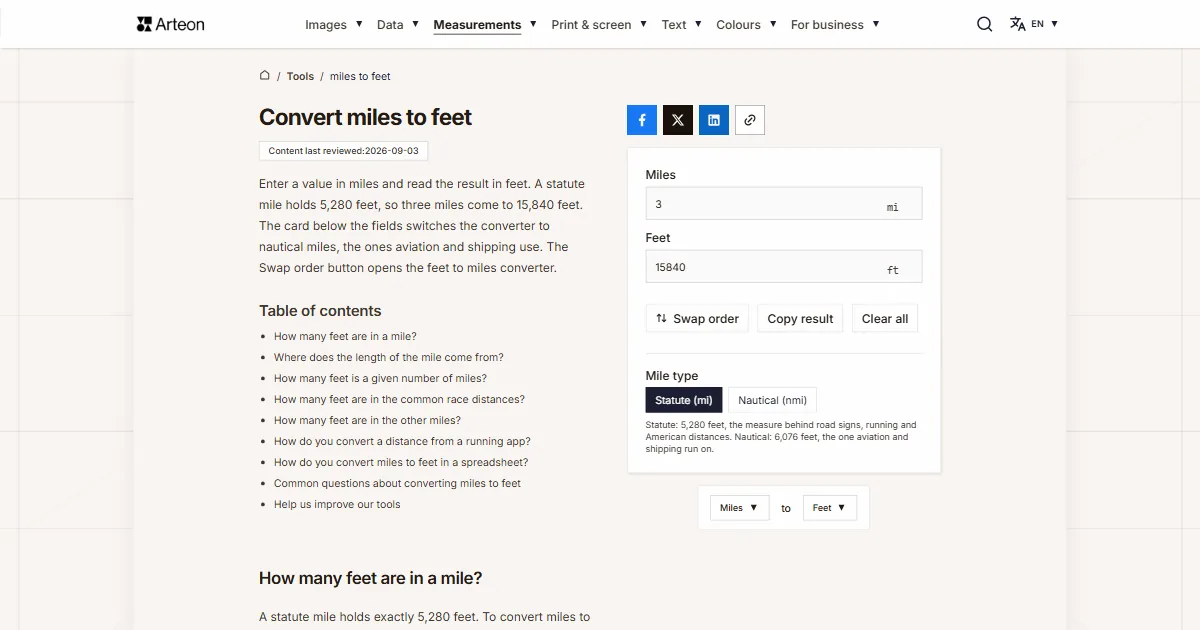
Enter a value in miles and read the result in feet. A statute mile holds 5,280 feet, so three miles come to 15,840 feet. The card below the fields switches the converter to nautical miles, the ones aviation and shipping use. The Swap order button opens the feet to miles converter.
How many feet are in a mile?
A statute mile holds exactly 5,280 feet. To convert miles to feet, multiply your value by that number.
A few results turn up more often than the rest. A quarter mile is 1,320 feet and half a mile is 2,640 feet. Three miles already come to 15,840 feet.
Going the other way, you divide by the same number, and the feet to miles converter will do it for you.
Formula: feet = miles × 5,280
The same distance can be written in other ways too. A mile holds 1,760 yards, and in metric units it comes to 1,609.344 metres[1], because a single foot measures 0.3048 metres[2].
Alongside the statute mile there is the nautical mile, and that is the one distances are measured in at sea and in the air. It is longer than the statute mile, and its value comes straight out of geography. One nautical mile matches one minute of latitude, which is a slice of the Earth's circumference.
Since 1929 it has been fixed at 1,852 metres[3], which works out at 6,076.115 feet. The multiplier becomes 6,076, and the gap against the statute mile reaches fifteen per cent.
Over short distances that gap stays small, but over longer ones it grows quickly. Ten nautical miles come to 60,761 feet, while ten statute miles come to 52,800 feet. Eight thousand feet of difference shows up on any chart.
You choose the kind of mile in the card below the fields, and the result updates the moment you switch.
If you need the answer in metric units, open the miles to metres, miles to kilometres or feet to metres converter.
Where does the length of the mile come from?
The name goes back to the Roman mille passus, a thousand double paces of a legionary. The Roman mile ran to a round 5,000 Roman feet, so its length was perfectly regular at the time. Converted into today's units that comes to roughly 1,479 metres[1], about eight per cent short of the mile we use now.
The number 5,280 was settled by an English act of parliament in 1593. Its wording runs: a mile shall contain eight furlongs, every furlong forty poles, and every pole sixteen and a half feet[1]. Eight times forty times sixteen and a half comes to exactly 5,280 feet.
Parliament kept the old length of the pole because fields were measured off it. Shortening the pole would have meant re-surveying every holding and raising the tax due on the land, so it was easier to add feet to the mile. That is why a number which looks arbitrary is really the arithmetic of three older units.
The furlong itself holds 660 feet and came from the length of a furrow a team of oxen could plough without a rest[4]. It remains in official use in horse racing in Britain, Ireland, Canada and the United States.
The present value was fixed on 1 July 1959, when the English-speaking countries harmonised the yard and the pound. From that day the mile has measured exactly 1,609.344 metres[1].
How many feet is a given number of miles?
| Miles | Feet | Kilometres |
|---|---|---|
| 0.1 mi | 528 ft | 0.161 km |
| 0.2 mi | 1,056 ft | 0.322 km |
| 0.25 mi | 1,320 ft | 0.402 km |
| 0.3 mi | 1,584 ft | 0.483 km |
| 0.4 mi | 2,112 ft | 0.644 km |
| 0.5 mi | 2,640 ft | 0.805 km |
| 0.6 mi | 3,168 ft | 0.966 km |
| 0.7 mi | 3,696 ft | 1.127 km |
| 0.75 mi | 3,960 ft | 1.207 km |
| 0.8 mi | 4,224 ft | 1.287 km |
| 0.9 mi | 4,752 ft | 1.448 km |
| 1 mi | 5,280 ft | 1.609 km |
| 1.1 mi | 5,808 ft | 1.77 km |
| 1.2 mi | 6,336 ft | 1.931 km |
| 1.25 mi | 6,600 ft | 2.012 km |
| 1.4 mi | 7,392 ft | 2.253 km |
| 1.5 mi | 7,920 ft | 2.414 km |
| 1.75 mi | 9,240 ft | 2.816 km |
| 2 mi | 10,560 ft | 3.219 km |
| 2.5 mi | 13,200 ft | 4.023 km |
| 3 mi | 15,840 ft | 4.828 km |
| 3.1 mi | 16,368 ft | 4.989 km |
| 3.5 mi | 18,480 ft | 5.633 km |
| 4 mi | 21,120 ft | 6.437 km |
| 4.5 mi | 23,760 ft | 7.242 km |
| 5 mi | 26,400 ft | 8.047 km |
| 6 mi | 31,680 ft | 9.656 km |
| 6.2 mi | 32,736 ft | 9.978 km |
| 7 mi | 36,960 ft | 11.265 km |
| 8 mi | 42,240 ft | 12.875 km |
| 9 mi | 47,520 ft | 14.484 km |
| 10 mi | 52,800 ft | 16.093 km |
| 12 mi | 63,360 ft | 19.312 km |
| 13.1 mi | 69,168 ft | 21.082 km |
| 15 mi | 79,200 ft | 24.14 km |
| 20 mi | 105,600 ft | 32.187 km |
| 25 mi | 132,000 ft | 40.234 km |
| 26.2 mi | 138,336 ft | 42.165 km |
| 30 mi | 158,400 ft | 48.28 km |
| 50 mi | 264,000 ft | 80.467 km |
| 100 mi | 528,000 ft | 160.934 km |
Four rows in the table match the classic race distances. A five-kilometre race falls at 3.1 miles, and a ten-kilometre race at 6.2 miles. A half marathon covers 13.1 miles, while a full marathon covers 26.2 miles.
How many feet are in the common race distances?
| Distance | Feet | Miles | Metres |
|---|---|---|---|
| Furlong (an eighth of a mile) | 660 ft | 0.125 mi | 201.2 m |
| One lap of a track | 1,312 ft | 0.249 mi | 400 m |
| Quarter mile | 1,320 ft | 0.25 mi | 402.3 m |
| The mile | 5,280 ft | 1 mi | 1,609.3 m |
| 5 kilometre race | 16,404 ft | 3.107 mi | 5,000 m |
| 10 kilometre race | 32,808 ft | 6.214 mi | 10,000 m |
| Half marathon | 69,218 ft | 13.109 mi | 21,097.5 m |
| Marathon | 138,435 ft | 26.219 mi | 42,195 m |
The marathon measures 42.195 kilometres and has done since May 1921. The athletics federation adopted the distance run at the 1908 London Olympics and wrote it permanently into the rules[5]. In imperial units the same distance reads as 26 miles and 385 yards, which comes to exactly 138,435 feet.
How many feet are in the other miles?
| Kind of mile | Feet | Kilometres | Against the statute mile | Where you meet it |
|---|---|---|---|---|
| Statute mile | 5,280 | 1.6093 | 1.000 | Running, roads and every American distance. |
| Nautical mile | 6,076.115 | 1.852 | 1.151 | Aviation and shipping worldwide, since 1929. |
| Data mile | 6,000 | 1.8288 | 1.136 | Radar work. |
| Admiralty mile | 6,080 | 1.8532 | 1.152 | The Royal Navy, until 1970. |
| US survey mile | 5,280 survey feet | 1.6093 | 1.000 | American land surveying, until 31 December 2022. |
| Roman mile | 5,000 Roman feet | about 1.479 | 0.919 | Ancient Rome, a thousand double paces of a legionary. |
| Irish mile | 6,720 | 2.0483 | 1.273 | Ireland, until the nineteenth century. |
The Irish mile ran to 2,240 yards and stayed in use from the sixteenth-century plantations onwards[6]. The Weights and Measures Act of 1824 replaced it with imperial measure, but the Irish Post Office kept working in it until 1856, so it still turns up on old maps and in old road books.
How do you convert a distance from a running app?
Apps set to imperial units report the distance in miles to two decimal places. Four steps turn that into feet.
Type the distance with its decimals
The field takes decimal values, so you enter 3.11 exactly as it appears on the app screen.Leave it on the statute mile
Running is measured in statute miles, so the Statute (mi) option stays selected in the card below the fields. The nautical mile is for flying and sailing.Read the result and copy it
Three point one one miles comes to 16,420.8 feet. The Copy result button puts that number on your clipboard.Compare it with the metric distance
A five-kilometre race comes to 3.107 miles and a ten-kilometre race to 6.214 miles. That lets you line your own run up against the race distances table. For other metric distances, use the kilometres to miles converter.
How do you convert miles to feet in a spreadsheet?
Put the number of miles in cell A1 and enter =A1*5280 in the cell next to it. Excel, Google Sheets and LibreOffice Calc all handle it the same way, and copying that cell downwards converts the whole column. For nautical miles only the multiplier changes, to =A1*6076.1155.
A decimal result can be split into whole miles and the feet left over. Whole miles come from =INT(A1), and the remainder in feet comes from =(A1-INT(A1))*5280. For 2.3 miles that gives two miles and 1,584 feet.
To round the feet to a whole number, wrap the sum in the rounding function: =ROUND(A1*5280, 0).
Sources
- Mile — Wikipedia
- U.S. Survey Foot: Revised Unit Conversion Factors — NIST
- Nautical mile — Wikipedia
- Furlong — Wikipedia
- Marathon — Wikipedia
- Irish mile — Wikipedia
Every figure in the tables was computed from the unit definitions and checked arithmetically before publication. Historical values and the names of local units come from the sources listed above.
Content last reviewed: · written and checked by the Arteon team
Common questions about converting miles to feet
Why does a mile have 5,280 feet exactly?
Because it is made of eight furlongs and each furlong holds 660 feet. Eight times 660 comes to exactly 5,280, and that is the whole arithmetic of the number. The furlong is older than the mile itself, since it came from the length of a furrow ploughed across a field.
How do you remember 5,280?
The usual trick in the States is "five tomatoes", which said aloud gives five, two, eight, oh. If you would rather work from the structure, a mile is eight furlongs of 660 feet, and that route also gives you the fractions: two furlongs make a quarter mile at 1,320 feet, and four furlongs make half a mile at 2,640 feet.
Why is a marathon 26 miles and 385 yards?
That was the length of the course at the 1908 London Olympics. The athletics federation adopted it as the standard in May 1921, and every marathon in the world has measured the same ever since. In metric units it comes to 42.195 kilometres, and in feet to exactly 138,435.
Which abbreviations are used for the statute and nautical mile?
The statute mile is written mi, and occasionally spelled out as mile. The nautical mile has three symbols depending on the body using it: civil aviation writes NM, hydrography writes M, and technical texts often use nmi. If your source shows any of these, pick the Nautical (nmi) option in the converter.
Is a mile in Britain the same as a mile in the States?
Yes. The agreement of 1 July 1959 harmonised the yard and the pound across the English-speaking countries, and the mile was set at exactly 1,609.344 metres. British and American road signs therefore quote the same distance.
What is the difference between a land mile and a geographical mile?
A statute mile of 5,280 feet is defined from older land units, while a geographical mile is defined from the size of the Earth. That second family gives the nautical mile of 6,076.115 feet, which matches one minute of latitude, and the data mile of 6,000 feet used in radar work.
Can you enter a fraction of a mile in the converter?
Yes. The field takes decimal values, so 0.25 gives 1,320 feet and 13.1 gives 69,168 feet. The result is calculated as you type, with no separate button to press.
Help us improve our tools
Have an idea for a new feature, found a bug, or want to suggest another tool? Write to us — we reply within 24 hours.