Convert feet to yards
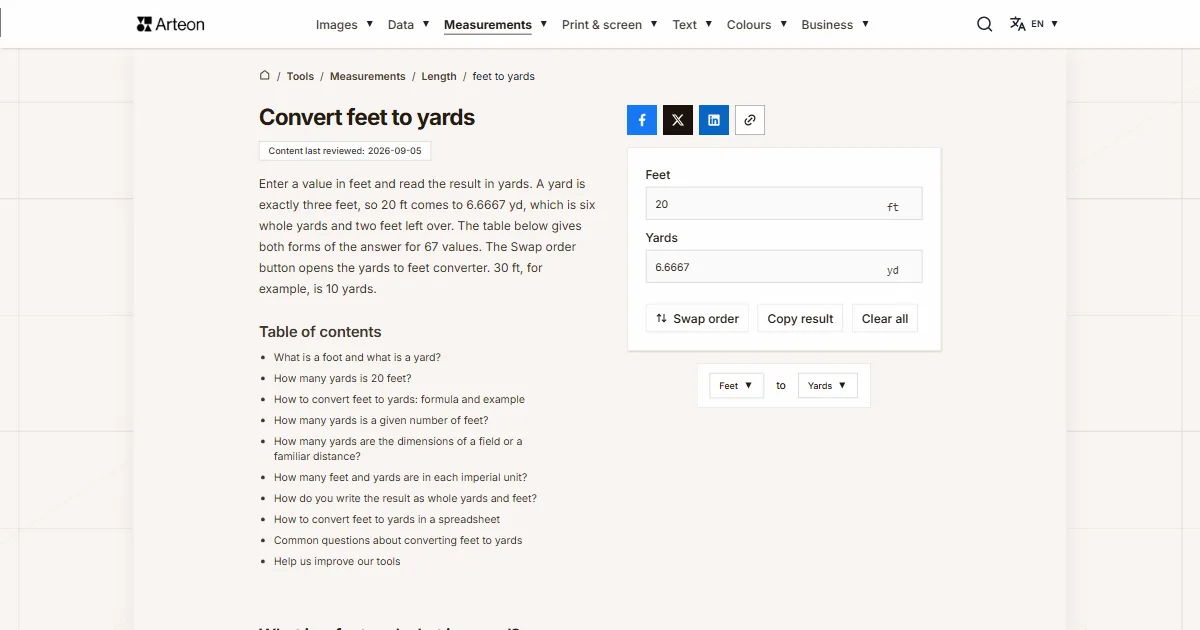
Enter a value in feet and read the result in yards. A yard is exactly three feet, so 20 ft comes to 6.6667 yd, which is six whole yards and two feet left over. The table below gives both forms of the answer for 67 values. The Swap order button opens the yards to feet converter. 30 ft, for example, is 10 yards.
What is a foot and what is a yard?
The foot and the yard belong to the same system of measures, the one still used day to day in the United States and the United Kingdom. Both units started out as body measurements, and both now have a length fixed to a tenth of a millimetre.
The foot, written ft, is exactly 0.3048 metres[1]. It divides into twelve inches. On American drawings and in catalogues it often appears as a single prime instead of the abbreviation, so 6′ means six feet.
The yard, written yd, is exactly 0.9144 metres[2], which leaves it 8.56 cm short of a metre. Three feet make one yard, and so do thirty-six inches — both spellings describe the same length.
Both figures come from a single document. On 1 July 1959 six countries, the United States and the United Kingdom among them, signed the agreement on a common yard and pound[2]. The yard was set at 0.9144 metres, and the foot, as a third of it, came out at 0.3048 metres. From that day the two units have meant the same thing on both sides of the Atlantic.
Britain still puts the yard on the road. Almost every warning sign that carries a distance gives it in yards, and the Traffic Signs Regulations of 2016 keep metric units off distance signs altogether[3]. The drawings behind those signs are metric, so a contractor sets a marker at 100 m and the sign in front of it reads 100 yards.
How many yards is 20 feet?
Twenty feet is 6.6667 yards. Written in whole units it is six yards and two feet.
That second form is the one you will want more often, because dividing by three rarely lands on a round number. Whole yards come out when the number of feet divides by three, so at 3, 6, 9, 12 and every further multiple of three.
A handful of values come up more often than the rest. Sixteen feet gives 5.3333 yards, which is five yards and one foot. One hundred feet is 33.3333 yards, or thirty-three yards and one foot in the mixed form. Three hundred feet lands exactly on one hundred yards, the length of an American football field measured between the goal lines.
Any other value is in the table below, or you can type it straight into the converter at the top of the page.
How to convert feet to yards: formula and example
Divide the number of feet by three and you have the answer in yards. Twenty-one feet works out at exactly seven yards.
Formula: yards = feet ÷ 3
Going the other way rests on the same number, with the division turning into a multiplication. Seven yards is 21 feet, and the yards to feet converter will do the whole swap for you.
The three in that formula is an exact value, and that sets this pair apart from every other imperial conversion. The foot has two definitions. The international one is 0.3048 metres; the survey foot is 1200/3937 metres and it was the one the United States used for land measurement. NIST retired it on 1 January 2023[4].
For feet to metres that difference matters, because each definition gives a different number. The ratio of a foot to a yard stays identical in both systems. The survey yard is 3600/3937 metres and the survey foot 1200/3937 metres, so the first divides by the second exactly three times. The international system gives the same answer: 0.9144 metres divided by 0.3048 metres is exactly three.
Whatever source your figure in feet came from, then, this converter returns the same result.
For a metric answer, use the feet to metres converter. Distances longer than a field are easier to read with the feet to miles converter, and anything smaller than a foot with the feet to inches converter.
How many yards is a given number of feet?
| Feet | Yards (yd) | Whole yards and feet | Metres (m) |
|---|---|---|---|
| 1 ft | 0.3333 yd | 0 yd 1 ft | 0.3048 m |
| 2 ft | 0.6667 yd | 0 yd 2 ft | 0.6096 m |
| 3 ft | 1 yd | 1 yd | 0.9144 m |
| 4 ft | 1.3333 yd | 1 yd 1 ft | 1.2192 m |
| 5 ft | 1.6667 yd | 1 yd 2 ft | 1.524 m |
| 6 ft | 2 yd | 2 yd | 1.8288 m |
| 7 ft | 2.3333 yd | 2 yd 1 ft | 2.1336 m |
| 8 ft | 2.6667 yd | 2 yd 2 ft | 2.4384 m |
| 9 ft | 3 yd | 3 yd | 2.7432 m |
| 10 ft | 3.3333 yd | 3 yd 1 ft | 3.048 m |
| 11 ft | 3.6667 yd | 3 yd 2 ft | 3.3528 m |
| 12 ft | 4 yd | 4 yd | 3.6576 m |
| 15 ft | 5 yd | 5 yd | 4.572 m |
| 16 ft | 5.3333 yd | 5 yd 1 ft | 4.8768 m |
| 18 ft | 6 yd | 6 yd | 5.4864 m |
| 19 ft | 6.3333 yd | 6 yd 1 ft | 5.7912 m |
| 20 ft | 6.6667 yd | 6 yd 2 ft | 6.096 m |
| 21 ft | 7 yd | 7 yd | 6.4008 m |
| 24 ft | 8 yd | 8 yd | 7.3152 m |
| 25 ft | 8.3333 yd | 8 yd 1 ft | 7.62 m |
| 27 ft | 9 yd | 9 yd | 8.2296 m |
| 28 ft | 9.3333 yd | 9 yd 1 ft | 8.5344 m |
| 30 ft | 10 yd | 10 yd | 9.144 m |
| 32 ft | 10.6667 yd | 10 yd 2 ft | 9.7536 m |
| 33 ft | 11 yd | 11 yd | 10.0584 m |
| 35 ft | 11.6667 yd | 11 yd 2 ft | 10.668 m |
| 36 ft | 12 yd | 12 yd | 10.9728 m |
| 39 ft | 13 yd | 13 yd | 11.8872 m |
| 40 ft | 13.3333 yd | 13 yd 1 ft | 12.192 m |
| 42 ft | 14 yd | 14 yd | 12.8016 m |
| 45 ft | 15 yd | 15 yd | 13.716 m |
| 48 ft | 16 yd | 16 yd | 14.6304 m |
| 50 ft | 16.6667 yd | 16 yd 2 ft | 15.24 m |
| 54 ft | 18 yd | 18 yd | 16.4592 m |
| 60 ft | 20 yd | 20 yd | 18.288 m |
| 66 ft | 22 yd | 22 yd | 20.1168 m |
| 70 ft | 23.3333 yd | 23 yd 1 ft | 21.336 m |
| 72 ft | 24 yd | 24 yd | 21.9456 m |
| 75 ft | 25 yd | 25 yd | 22.86 m |
| 80 ft | 26.6667 yd | 26 yd 2 ft | 24.384 m |
| 90 ft | 30 yd | 30 yd | 27.432 m |
| 94 ft | 31.3333 yd | 31 yd 1 ft | 28.6512 m |
| 100 ft | 33.3333 yd | 33 yd 1 ft | 30.48 m |
| 110 ft | 36.6667 yd | 36 yd 2 ft | 33.528 m |
| 120 ft | 40 yd | 40 yd | 36.576 m |
| 150 ft | 50 yd | 50 yd | 45.72 m |
| 160 ft | 53.3333 yd | 53 yd 1 ft | 48.768 m |
| 164 ft | 54.6667 yd | 54 yd 2 ft | 49.9872 m |
| 180 ft | 60 yd | 60 yd | 54.864 m |
| 200 ft | 66.6667 yd | 66 yd 2 ft | 60.96 m |
| 250 ft | 83.3333 yd | 83 yd 1 ft | 76.2 m |
| 300 ft | 100 yd | 100 yd | 91.44 m |
| 328 ft | 109.3333 yd | 109 yd 1 ft | 99.9744 m |
| 350 ft | 116.6667 yd | 116 yd 2 ft | 106.68 m |
| 360 ft | 120 yd | 120 yd | 109.728 m |
| 400 ft | 133.3333 yd | 133 yd 1 ft | 121.92 m |
| 450 ft | 150 yd | 150 yd | 137.16 m |
| 500 ft | 166.6667 yd | 166 yd 2 ft | 152.4 m |
| 600 ft | 200 yd | 200 yd | 182.88 m |
| 700 ft | 233.3333 yd | 233 yd 1 ft | 213.36 m |
| 800 ft | 266.6667 yd | 266 yd 2 ft | 243.84 m |
| 900 ft | 300 yd | 300 yd | 274.32 m |
| 1,000 ft | 333.3333 yd | 333 yd 1 ft | 304.8 m |
| 1,200 ft | 400 yd | 400 yd | 365.76 m |
| 1,500 ft | 500 yd | 500 yd | 457.2 m |
| 2,000 ft | 666.6667 yd | 666 yd 2 ft | 609.6 m |
| 5,280 ft | 1,760 yd | 1,760 yd | 1,609.344 m |
How many yards are the dimensions of a field or a familiar distance?
| Distance | Feet (ft) | Yards (yd) | Metres (m) |
|---|---|---|---|
| American football field, between the goal lines | 300 ft | 100 yd | 91.44 m |
| American football field, including both end zones | 360 ft | 120 yd | 109.73 m |
| Width of an American football field | 160 ft | 53.33 yd | 48.77 m |
| End zone, and the distance needed for a new set of downs | 30 ft | 10 yd | 9.14 m |
| NFL hash marks from the sideline | 70.75 ft | 23.58 yd | 21.56 m |
| College hash marks from the sideline | 60 ft | 20 yd | 18.29 m |
| Cricket pitch, length | 66 ft | 22 yd | 20.12 m |
| Cricket pitch, width | 10 ft | 3.33 yd | 3.05 m |
| NBA basketball court, length | 94 ft | 31.33 yd | 28.65 m |
| Tennis court, length | 78 ft | 26 yd | 23.77 m |
| Short-course pool in the United States | 75 ft | 25 yd | 22.86 m |
| NFL Combine sprint | 120 ft | 40 yd | 36.58 m |
| One hundred metres of a running track | 328.08 ft | 109.36 yd | 100 m |
How many feet and yards are in each imperial unit?
| Unit | Feet (ft) | Yards (yd) | Metres (m) |
|---|---|---|---|
| Inch | 0.0833 ft | 0.0278 yd | 0.0254 m |
| Hand | 0.3333 ft | 0.1111 yd | 0.1016 m |
| Foot | 1 ft | 0.3333 yd | 0.3048 m |
| Yard | 3 ft | 1 yd | 0.9144 m |
| Fathom | 6 ft | 2 yd | 1.8288 m |
| Rod | 16.5 ft | 5.5 yd | 5.0292 m |
| Chain | 66 ft | 22 yd | 20.1168 m |
| Furlong | 660 ft | 220 yd | 201.168 m |
| Mile | 5,280 ft | 1,760 yd | 1,609.344 m |
How do you write the result as whole yards and feet?
The converter gives the answer as one number with a decimal part. The four steps below turn it into the form used on a field and on a building site. The worked example is 20 feet.
Divide the number of feet by three
Twenty feet divided by three is 6.6667. That is the value the converter shows in the result field once you type the number in.Take the whole part as yards
From 6.6667 you keep the six on its own. Those are the whole yards and the first half of the answer.Multiply the whole yards back by three
Six yards is 18 feet. That number says how many feet the whole yards account for.Subtract that from the figure you started with
Twenty feet minus 18 feet leaves 2 feet. The full answer reads six yards and two feet. The remainder is always zero, one or two feet, because a third one closes the next whole yard.
How to convert feet to yards in a spreadsheet
Type the number of feet into cell A1 and put the formula =A1/3 in the cell beside it. Excel, Google Sheets and LibreOffice Calc all read it the same way, and copying that cell down converts the whole column.
The built-in unit function gives the same answer: =CONVERT(A1,"ft","yd"). Unit codes go in quotation marks[8].
For the whole yards, round down with =INT(A1/3). The leftover feet come from the remainder: =MOD(A1,3). For twenty feet the first formula returns 6 and the second returns 2, which is exactly six yards and two feet.
Convert other units to Yards
Convert Feet to other units
Sources
- Foot (unit) — Wikipedia
- Yard — Wikipedia
- Road signage and distance information — UK Metric Association
- U.S. Survey Foot: Revised Unit Conversion Factors — NIST
- American football field — Wikipedia
- Cricket pitch — Wikipedia
- Imperial units — Wikipedia
- CONVERT function — Microsoft
Every figure in the tables was computed from the unit definitions and checked arithmetically before publication. Historical values and the names of local units come from the sources listed above.
Content last reviewed: · written and checked by the Arteon team
Common questions about converting feet to yards
How many yards is 20 feet?
Twenty feet is 6.6667 yards, which is six whole yards and two feet on top. The working is 20 divided by 3.
Is a yard always exactly three feet?
Yes, and the three is an exact value rather than a rounded one. A yard is 0.9144 metres and a foot is 0.3048 metres, so the first divides by the second exactly three times. The same ratio held in the now retired US survey system, where a yard was 3600/3937 metres and a foot 1200/3937 metres.
Why does the result have so many decimal places?
Dividing by three gives a repeating decimal for every number of feet that is not a multiple of three. One foot is 0.3333 yards and two feet is 0.6667 yards. That is why the table carries a second form of the answer beside the decimal column: whole yards and the feet left over.
How many yards is 100 feet?
One hundred feet is 33.3333 yards, which is thirty-three yards and one foot. The same distance measures 30.48 metres.
What does linear feet mean?
Linear feet are ordinary feet measured along a single direction, and the trade uses the phrase to separate the length of a material from its area. One hundred linear feet of fencing is one hundred feet, so the working is the same: 100 divided by 3 gives 33.3333 yards, or thirty-three yards and one foot.
What is the survey foot and does it change this result?
The US survey foot was 1200/3937 metres and from 1866 it served for land measurement in the United States. NIST retired it on 1 January 2023. It leaves this conversion untouched, because a yard counts exactly three feet in either system. It starts to matter for feet to metres, where each definition gives a different number.
Does a yard have the same number of feet in Britain as in the United States?
It does. The agreement of 1 July 1959 gave the two countries one yard, and Britain wrote that value into the Weights and Measures Act 1963, in force from 1 January 1964. In both countries a yard is 0.9144 metres and divides into three feet.
Help us improve our tools
Have an idea for a new feature, spotted a bug or want to suggest another tool? Write to us — we reply within 24 hours.