Convert meters to kilometers
Enter a value in meters and read the result in kilometers. 1,000 meters is 1 km, so 5,000 m gives 5 km. Below there is a table of thirty ready conversions, track and pool distances, and the formula to drop into a spreadsheet.
What is a meter, and what is a kilometer?
The meter is the SI base unit of length, the one every other length unit is counted from. Since 1983 its value has been set by the speed of light: a meter is the distance light travels in a vacuum in 1/299,792,458 of a second[1]. A definition built on a physical constant has an advantage over the old bar standard, because any laboratory can reproduce it on its own bench.
A kilometer is a multiple of the meter. The prefix kilo- multiplies a unit by a thousand, so a kilometer holds 1,000 meters. The same rule runs through the whole system: a kilogram is a thousand grams, and a kilobyte a thousand bytes.
Which unit you use comes down to convenient numbers. Meters describe distances on a track, the length of a pool and the height of a building. Kilometers describe a road race, the mileage on a car and the gap between two cities.
How many kilometers are in 1,000 meters?
One thousand meters is 1 kilometer. Five hundred meters works out to 0.5 kilometers. One hundred meters is 0.1 kilometers. Every conversion in this direction comes down to dividing the number of meters by a thousand.
Beyond the round thousand, three values come up in search more often than the rest. Two hundred and fifty meters is 0.25 kilometers. Seven hundred and fifty meters gives 0.75 kilometers. Two thousand five hundred meters works out to 2.5 kilometers.
The converter above runs both ways and shows the result as you type, so none of these numbers is worth memorizing.
How do you convert meters to kilometers? Formula and example
The conversion rests on a fixed relationship: one kilometer is 1,000 meters. To turn meters into kilometers, you divide their number by a thousand.
The full formula: kilometers = meters ÷ 1000. The other way round: meters = kilometers × 1000.
Three numbers follow from that formula more often than any others. Five hundred meters divided by a thousand gives 0.5 kilometers. One thousand five hundred meters comes out at 1.5 kilometers the same way. Ten thousand meters gives an even 10 kilometers.
When you divide by a thousand the digits stay as they are and the decimal point moves three places to the left. From 42,195 meters you get 42.195 kilometers. When there are not enough places to move through, you add zeros in front, so five meters turn into 0.005 kilometers.
The same arithmetic reversed, multiplying by a thousand, is what the kilometers to meters converter does.
How many kilometers are in a given number of meters?
| Meters | Kilometers |
|---|---|
| 1 m | 0.001 km |
| 5 m | 0.005 km |
| 10 m | 0.01 km |
| 50 m | 0.05 km |
| 100 m | 0.1 km |
| 150 m | 0.15 km |
| 200 m | 0.2 km |
| 250 m | 0.25 km |
| 300 m | 0.3 km |
| 400 m | 0.4 km |
| 500 m | 0.5 km |
| 600 m | 0.6 km |
| 750 m | 0.75 km |
| 800 m | 0.8 km |
| 1,000 m | 1 km |
| 1,200 m | 1.2 km |
| 1,500 m | 1.5 km |
| 2,000 m | 2 km |
| 2,500 m | 2.5 km |
| 3,000 m | 3 km |
| 4,000 m | 4 km |
| 5,000 m | 5 km |
| 6,000 m | 6 km |
| 8,000 m | 8 km |
| 10,000 m | 10 km |
| 15,000 m | 15 km |
| 20,000 m | 20 km |
| 21,097.5 m | 21.0975 km |
| 42,195 m | 42.195 km |
| 100,000 m | 100 km |
The 21,097.5 m and 42,195 m rows are the half marathon and the marathon written in meters. For the same distances in miles, use the meters to miles converter.
How many kilometers are the standard track and pool distances?
| Meters | Kilometers | What the distance is |
|---|---|---|
| 25 m | 0.025 km | Length of a short-course pool |
| 50 m | 0.05 km | Length of an Olympic pool |
| 100 m | 0.1 km | Sprint down the straight |
| 200 m | 0.2 km | Sprint with one bend |
| 400 m | 0.4 km | One lap of the track in lane 1 |
| 453.03 m | 0.45303 km | One lap of the track in lane 8 |
| 800 m | 0.8 km | Two laps of the track |
| 1,500 m | 1.5 km | Three and three quarter laps |
| 3,000 m | 3 km | Seven and a half laps |
| 5,000 m | 5 km | Twelve and a half laps |
| 10,000 m | 10 km | Twenty-five laps |
| 21,097.5 m | 21.0975 km | Half marathon |
| 42,195 m | 42.195 km | Marathon |
The 400 meters applies to lane 1, measured 30 centimeters out from the kerb. Lane 8 runs a wider arc and covers 453.03 meters on the same oval, which is why the longer track races start with the runners staggered[2]. 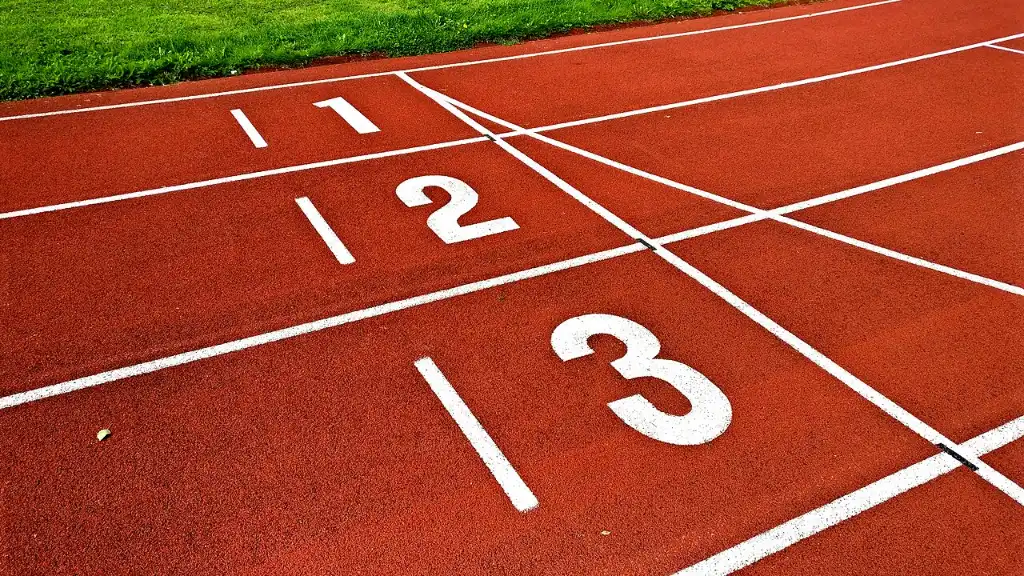
What is a thousand kilometers called?
| Unit | Symbol | Meters | Kilometers |
|---|---|---|---|
| Kilometer | km | 1,000 m | 1 km |
| Megameter | Mm | 1,000,000 m | 1,000 km |
| Gigameter | Gm | 1,000,000,000 m | 1,000,000 km |
| Terameter | Tm | 10¹² m | 10⁹ km |
| Petameter | Pm | 10¹⁵ m | 10¹² km |
The notation 10¹² stands for a one followed by twelve zeros. It is how distances get written once spelling out every digit stops being readable. The smaller units, from the millimeter to the hectometer, are collected on the kilometers to meters converter.
Where did the ten thousand kilometers from the equator to the pole come from?
The factor of a thousand comes from the prefix, but the length of the meter itself came from a survey of the Earth. When France settled on the new unit in the 1790s, a meter was to be one ten-millionth of the distance from the equator to the North Pole, measured along the meridian through Paris[4].
That starting point produces a figure which is easy to hold on to. If a meter is a ten-millionth of the distance, then the whole distance is ten million meters. Divided by a thousand, that comes to an even 10,000 kilometers.
Today's measurement lands slightly higher. On the WGS84 ellipsoid, the model of the Earth that GPS works on, the quarter meridian measures 10,001,965.729 meters[5]. That is a little under two kilometers more than the makers of the meter had assumed.
The gap traces back to a survey carried out two centuries ago. The expedition led by Delambre and Méchain left out the deflection of the vertical at the southern end of the arc they measured, and the finished meter came out 0.197 millimeters shorter than intended[4]. That fraction of a millimeter repeated ten million times accounts for roughly those two kilometers.
Sources
- SI base unit: metre (m) — Bureau International des Poids et Mesures
- All-weather running track — Wikipedia
- Olympic-size swimming pool — Wikipedia
- History of the metre — Wikipedia
- Meridian arc — Wikipedia
- Kilometre — Wikipedia
Every figure in the tables was computed from the unit definitions and checked arithmetically before publication. Historical values and the names of local units come from the sources listed above.
Content last reviewed: · written and checked by the Arteon team
Common questions about converting meters to kilometers
How many kilometers are in 1,000 meters?
One thousand meters is exactly 1 kilometer. Two thousand meters gives 2 kilometers, and five hundred meters 0.5 kilometers.
How many kilometers are 500 meters?
Five hundred meters is 0.5 kilometers, or half a kilometer. Two hundred and fifty meters gives 0.25 kilometers.
How many kilometers are 100 meters?
One hundred meters is 0.1 kilometers. Ten such stretches make up a kilometer.
How many laps of a track make a kilometer?
A kilometer takes two and a half laps in lane 1, because one lap is 400 meters. The 5,000 meters is twelve and a half laps, and the 10,000 meters twenty-five laps.
How many pool lengths make a kilometer?
In an Olympic pool of 50 meters a kilometer is twenty lengths. In a short-course pool of 25 meters it is forty lengths.
Why do soldiers call a kilometer a klick?
Klick is slang for a kilometer in the US, British and Canadian militaries[6]. One klick is 1,000 meters, so five klicks describe the same distance as a 5K road race.
Does the field accept decimals?
Yes. You can type 1500.5, and a simple fraction such as 1/2 works as well. The result appears as you type, with no separate button to press.
Have a question or suggestion?
If you spotted an error in the tables or have an idea to improve the converter, write to us — we reply within 24 hours.